
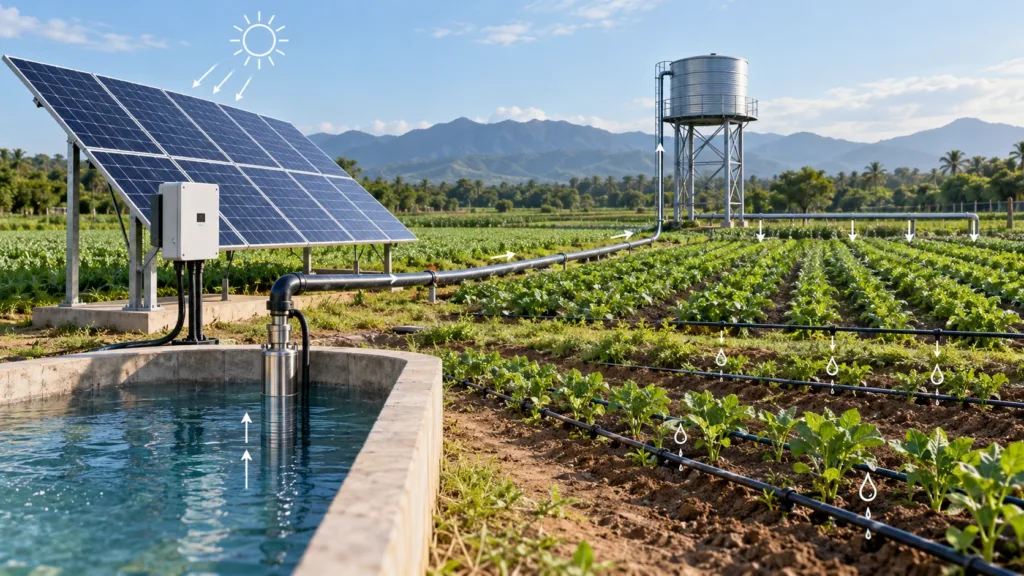
How do you size a solar water pump for irrigation? Start by calculating the daily irrigation water requirement, convert that demand into the required pumping flow, calculate total dynamic head (TDH) including lift, irrigation pressure and pipe losses, and define the pump duty point. Then match that duty point to a verified pump performance curve before sizing the controller and PV array.
Correct solar water pump sizing for irrigation starts with the farm’s hydraulic requirements, not with motor horsepower or a fixed number of solar panels. A well-designed solar water pump irrigation system must deliver the required water volume, flow and pressure at the real operating head while remaining compatible with the water source, pipe network, controller and available solar energy.
For drip irrigation, sprinklers, deep-well pumping and remote agricultural water supply, poor sizing can result in insufficient flow, weak pressure, excessive pipe losses or an unnecessarily expensive solar system.
Quick Solar Irrigation Pump Sizing Sequence
Crop & Field Area → Daily Water Demand → Irrigation Efficiency → Required Flow → Irrigation Zones → Water Source → Dynamic Water Level → TDH → Irrigation Pressure → Duty Point → Pump Curve → Source Yield → Pipe System → Storage Strategy → Controller → PV Array
Key principle: size the hydraulic system first. Size the solar power system second.
The 3 Numbers You Need Before Choosing a Pump
If only three project values are available, start with daily water requirement, required flow and TDH. These values define the hydraulic duty the pump must meet.
| Required Value | What It Tells You |
|---|---|
| Daily water requirement | How much water the crop or field requires during the design period. |
| Required pumping flow | How quickly that daily volume must be delivered. |
| Total dynamic head (TDH) | The hydraulic head the pump must overcome, including lift, pressure and friction losses. |
Together, required flow + required TDH define the pump’s duty point. This duty point is much more useful for selecting a pump than horsepower, maximum head or maximum flow alone.
What Information Do You Need Before Sizing a Solar Irrigation Pump?
| Project Data | Why It Matters |
|---|---|
| Crop type and growth stage | Helps determine irrigation water demand. |
| Irrigated area | Used to calculate total daily water volume. |
| Irrigation depth | Defines how much water is applied over the field. |
| Irrigation method | Changes required flow and operating pressure. |
| Water source | Determines the pump type and lifting conditions. |
| Static and dynamic water levels | Important for borehole and deep-well systems. |
| Water-source yield | Limits the sustainable pumping rate. |
| Pipe length and diameter | Used to estimate friction losses. |
| Field elevation | Adds delivery head. |
| Required irrigation pressure | Adds pressure head for drip, sprinkler, filtration or fertigation equipment. |
| Available pumping hours | Used to convert daily water demand into required flow. |
| Local solar conditions | Affect daily pumping energy and PV-array design. |
Based on our experience manufacturing solar pumps for agricultural and off-grid water applications, the most reliable pump selections begin with the actual daily water requirement, required flow and total dynamic head rather than field size or motor horsepower alone.
Step 1: Calculate Daily Irrigation Water Demand
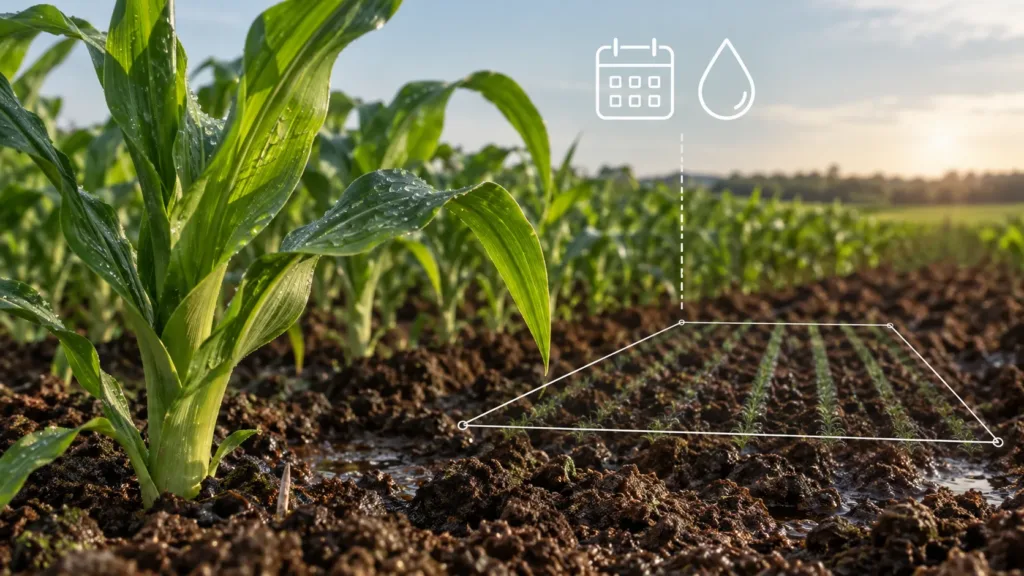
The first step is to determine how much water the crop needs during the design period.
Actual irrigation demand can depend on crop type, growth stage, evapotranspiration, rainfall, soil conditions, temperature, wind and irrigation schedule.
Convert Irrigation Depth Into Water Volume
A useful agricultural conversion is:
1 mm of irrigation over 1 hectare = 10 m³ of water
Therefore:
Daily Water Volume (m³/day) = Irrigation Depth (mm/day) × Field Area (ha) × 10
Example
Suppose a 2-hectare field (about 4.9 acres) has an example net irrigation requirement of 5 mm/day:
5 × 2 × 10 = 100 m³/day
The net irrigation water requirement is therefore approximately 100 m³/day.
Important: 5 mm/day is an example only. Actual irrigation depth should come from crop, climate, rainfall, soil and irrigation-planning data.
For more background on agricultural water planning, see our daily water requirements guide for livestock and irrigation.
Step 2: Account for Irrigation Efficiency
The crop’s net water requirement is not always the same as the amount of water that must be pumped. Losses can occur through evaporation, runoff, leakage and uneven distribution.
A simplified relationship is:
Gross Water Requirement = Net Water Requirement ÷ Irrigation Efficiency
Example
If the net requirement is 100 m³/day and the system uses an example efficiency of 85%:
100 ÷ 0.85 ≈ 118 m³/day
The system would therefore need to pump approximately 118 m³/day in this example.
Important: 85% is not a universal irrigation efficiency. Actual efficiency depends on system design, distribution uniformity, maintenance and field conditions.
Step 3: Determine the Required Pumping Flow Rate
Once daily water volume is known, determine how quickly that water must be delivered.
Required Average Flow = Daily Water Requirement ÷ Available Pumping Hours
Example
If the gross requirement is approximately 118 m³/day and the preliminary design assumes 7 effective pumping hours:
118 ÷ 7 ≈ 16.9 m³/h
The preliminary required flow is therefore approximately 17 m³/h.
In US units, 17 m³/h is approximately 75 GPM.
Do not treat seven hours as a universal solar pumping period. Effective pumping time depends on location, season, irradiance, PV sizing, controller operation, pump characteristics and water-storage strategy.
Step 4: Check Irrigation Zones Before Finalizing Flow
Large farms are often divided into irrigation zones rather than operating every sprinkler or drip line simultaneously.
Zoning can reduce the instantaneous pump flow requirement while still allowing the total daily water target to be delivered over the full irrigation schedule.
The pump should therefore be checked against the flow and pressure required by the active irrigation zone, while the complete irrigation schedule must still deliver the required daily volume.
Step 5: Identify the Water Source and Pump Type
| Water Source | Typical Pump Approach | Main Selection Data |
|---|---|---|
| Deep well or borehole | Solar submersible pump | Dynamic water level, borehole diameter, flow, TDH and well yield |
| Pond, canal, river or reservoir | Surface or submersible pump depending on installation | Water level, suction conditions, delivery elevation and pressure |
| Storage tank | Surface or transfer pump depending on layout | Tank elevation, downstream pressure, flow and pipe losses |
Deep Well or Borehole
For groundwater systems, determine total borehole depth, static water level, dynamic water level, borehole diameter and sustainable well yield.
Well depth is not the same as pump head. A 100 m deep borehole does not automatically mean the pump must overcome 100 m of vertical lift.
The dynamic water level while pumping is generally more relevant to the actual lifting requirement.
For more detail, see our solar submersible pump guide for remote wells and boreholes.
Typical Pump Configurations for Irrigation Projects
For deep-well irrigation, 3-inch and 4-inch stainless-steel solar submersible pumps are practical starting options when the borehole diameter and required duty point are suitable. For ponds, canals, reservoirs and storage tanks, a surface pump or another submersible configuration may be more appropriate depending on the suction conditions, installation layout and required pressure.
Depending on the model and project requirements, the system may use DC solar operation or an AC/DC hybrid configuration with an MPPT solar pump controller. Controller functions such as dry-run protection, water-level control and tank-full stop should be confirmed for the specific model.
The final pump should still be selected from the required flow + TDH duty point, sustainable source yield, pipe system, borehole clearance and controller compatibility rather than from pump diameter, maximum head or horsepower alone.
Step 6: Calculate Total Dynamic Head (TDH)
Total Dynamic Head is the total hydraulic head the pump must overcome while delivering the required flow.
For many irrigation systems:
TDH = Water Lift + Delivery Elevation + Required Pressure Head + Friction Losses
For deep-well irrigation:
TDH = Dynamic Water Level Lift + Field Elevation + Irrigation Pressure Head + Pipe and Equipment Losses
Example
- Dynamic water level: 35 m
- Field elevation: 8 m
- Required irrigation pressure head: 25 m
- Estimated pipe, filter and fitting losses: 7 m
35 + 8 + 25 + 7 = 75 m TDH
In US units, 75 m is approximately 246 ft of head.
Common mistake: do not use total well depth as TDH unless the actual hydraulic conditions require it.
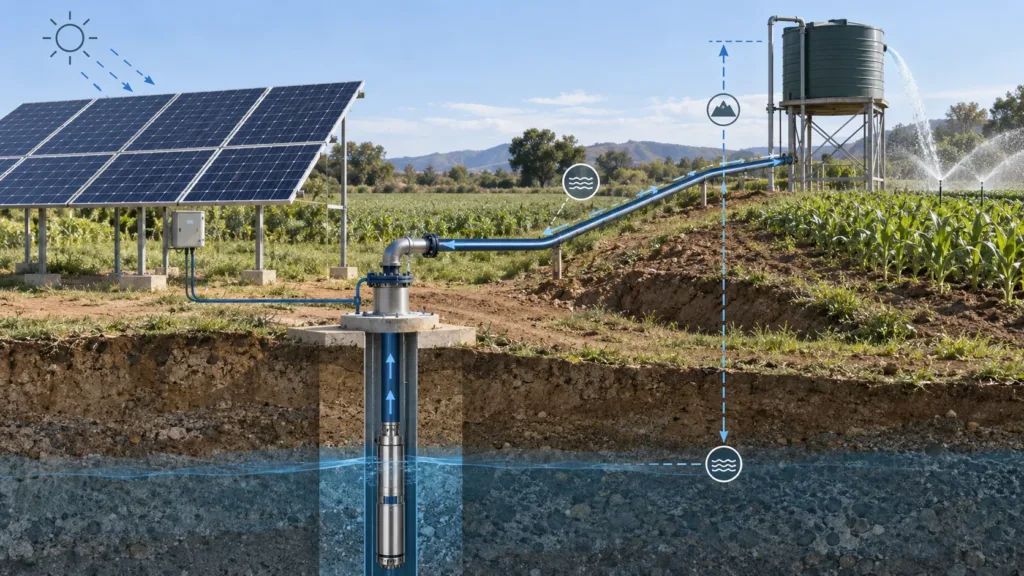
Figure: TDH combines the actual water lift, field elevation, required irrigation pressure and hydraulic losses.
Step 7: Include Irrigation Pressure Requirements
An irrigation pump does more than move water from one elevation to another. Drip and sprinkler systems often need a minimum operating pressure.
A useful hydraulic conversion is:
1 bar ≈ 10.2 m of water head ≈ 14.5 psi
For example, an irrigation inlet requiring 2.5 bar (about 36 psi) corresponds to approximately 25.5 m of pressure head before other losses are added.
The actual required pressure should come from the irrigation-equipment design or manufacturer specifications. Do not assume one universal pressure for every drip or sprinkler system.
Step 8: Determine the Pump Duty Point
Once flow and TDH are known, combine them into the required pump duty point.
Duty Point = Required Flow at Required Head
Using the example above:
- Required flow: approximately 17 m³/h
- Total dynamic head: approximately 75 m
The required duty point is:
17 m³/h @ 75 m TDH
Or approximately:
75 GPM @ 246 ft of head
This is the main operating point that should be compared with the manufacturer’s verified pump performance curve.
Step 9: Select the Pump Using the Performance Curve
Compare the required duty point with the manufacturer’s verified pump curve.
Do not select a pump based only on maximum head, maximum flow or horsepower.
Maximum head normally occurs near very low flow, while maximum flow occurs at much lower head. They should not be treated as simultaneous values.
The correct question is:
Can this pump deliver approximately 17 m³/h at 75 m TDH?
Where practical, the selected duty point should fall within an appropriate operating region of the manufacturer’s performance curve rather than near an extreme end.
In a variable-speed solar pumping system, the actual operating point can move during the day as available solar power and pump speed change. The design duty point is still the primary reference for model selection and system verification.
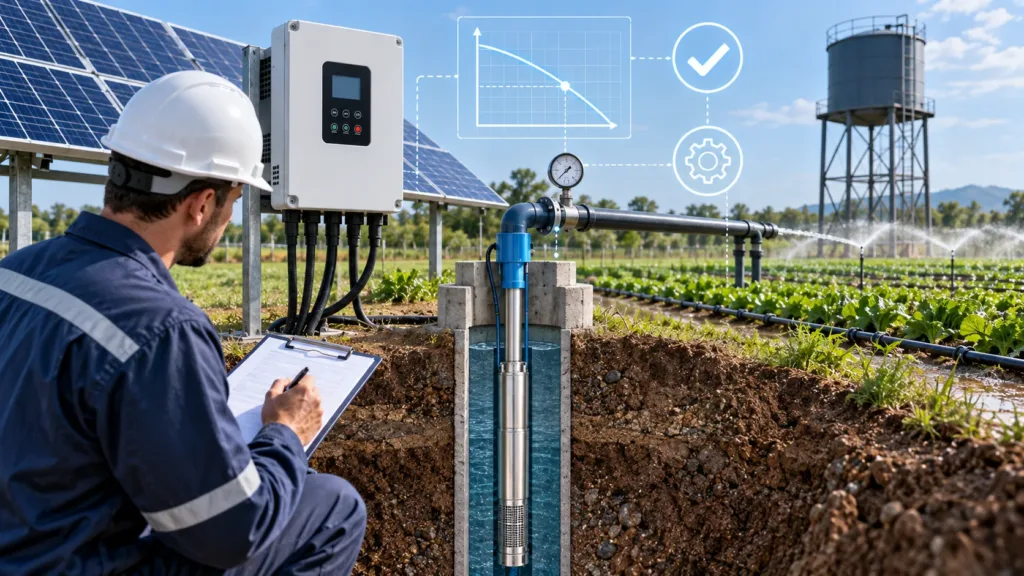
Figure: Match the required flow and TDH to the manufacturer’s verified pump curve instead of selecting by maximum head or horsepower alone.
Solar Irrigation Pump Selection
Have Your Flow and TDH? Let Us Match the Pump.
Send us your daily water demand, required flow, dynamic water level, source yield, field elevation, irrigation pressure, pipe length, pipe diameter and irrigation method. We can check the duty point and recommend a suitable solar pump and controller configuration.
Step 10: Verify Water-Source Yield
A pump cannot sustainably deliver more water than the source can provide.
For boreholes, compare required pump flow with tested well yield, dynamic water level, drawdown and recovery rate.
If the selected pump can deliver 17 m³/h but the well can sustainably provide only 10 m³/h, the system must be adjusted.
Possible solutions include:
- Lower pumping flow
- Longer pumping time
- Intermediate storage
- Revised irrigation zoning or schedule
- Water-level or dry-run protection where supported by the controller
Step 11: Check Pipe Diameter and Friction Loss
Pipe friction is one of the most common hidden sources of head loss in agricultural irrigation systems.
Friction loss depends on:
- Flow rate
- Pipe internal diameter
- Pipe length
- Pipe material
- Elbows and bends
- Valves
- Filters
- Other fittings
Long or undersized pipes can significantly increase TDH and reduce actual field pressure.
Step 12: Decide Between Direct Solar Irrigation and Water Storage
Direct Solar Irrigation
The pump supplies the irrigation network directly while sufficient solar energy is available.
The pump must provide the required zone flow and irrigation pressure during operation.
Solar Pump Plus Water Storage
The pump fills a storage tank or reservoir during available solar hours, and irrigation takes place later using gravity or a secondary pressure system.
The main advantage is that water storage separates pumping time from irrigation time.
This can be useful when irrigation is needed early in the morning, late in the day or at times that do not match peak solar availability.
Water storage is not the same as battery storage. In many agricultural projects, storing pumped water can shift irrigation timing without storing electricity, although the final choice still depends on required pressure, tank elevation and farm operating schedule.
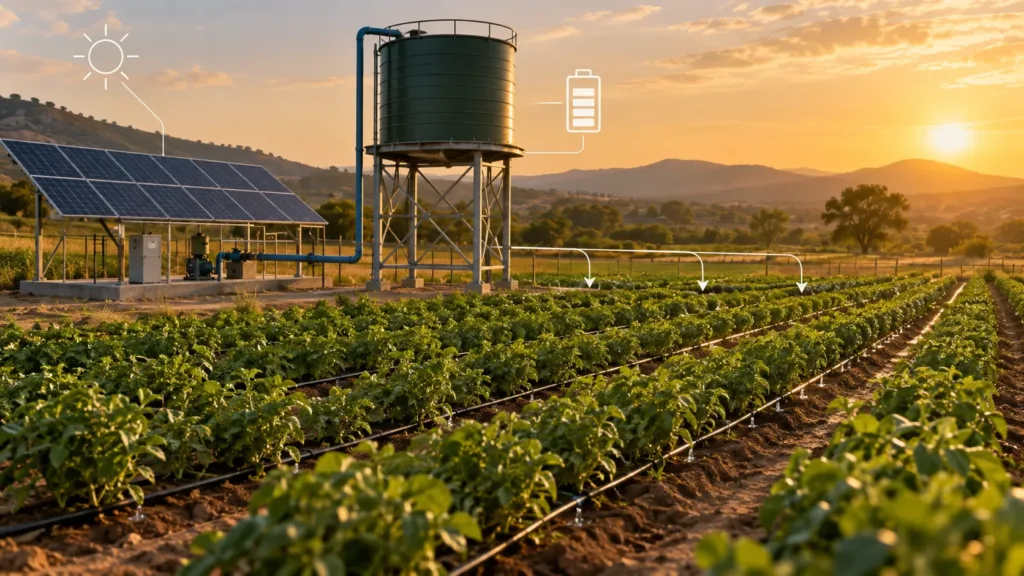
Figure: Direct solar irrigation supplies the field in real time, while water storage separates pumping time from irrigation time.
Step 13: Match the Solar Pump Controller
After the pump has been selected hydraulically, the controller must be matched to the pump and PV array.
Important parameters include:
- Pump rated power
- Pump rated voltage
- Motor type
- Controller input voltage range
- Controller maximum input voltage
- Operating current
- PV-array voltage and power limits
Depending on the controller model, available functions may include MPPT, dry-run or water-shortage protection, water-level control, tank-full stop, over-current protection, over-voltage protection and under-voltage protection. These functions should be verified for the exact controller supplied with the project.
For projects requiring backup operation, an AC/DC hybrid system can be considered where supported by the pump and controller.
For a broader explanation of system architecture, see our guide to the key components and working principles of solar water pumps.
Step 14: Size the PV Array
The solar array should be designed only after the hydraulic duty point, pump model and controller requirements are known.
PV sizing should consider:
- Pump power
- Pump operating voltage
- Controller requirements
- PV module Vmp
- PV module Voc
- Temperature effects on voltage
- Local irradiance
- Seasonal solar variation
- Required daily water production
- Expected system losses
There is no universal number of solar panels for an irrigation pump.
The same pump can require different module quantities when different panel wattages and electrical characteristics are used.
Design for the Critical Irrigation Period
The system should not be sized only around average annual or ideal solar conditions.
The critical design period is the period that creates the most difficult combination of:
- High crop water demand
- Available solar energy
- Water-source capacity
- Required daily pumping time
The important question is:
Can the system deliver enough water during the most demanding irrigation period?
For more background on reduced-sunlight operation, see our guide to solar water pump performance on cloudy days.
Complete Solar Irrigation Pump Sizing Example
| Design Item | Example Value |
|---|---|
| Irrigated area | 2 ha (about 4.9 acres) |
| Net irrigation depth | 5 mm/day |
| Net water demand | 100 m³/day |
| Example irrigation efficiency | 85% |
| Gross water requirement | 118 m³/day |
| Example effective pumping time | 7 h/day |
| Dynamic water level | 35 m |
| Field elevation | 8 m |
| Required pressure head | 25 m |
| Estimated losses | 7 m |
| Required flow | 17 m³/h (about 75 GPM) |
| Total dynamic head | 75 m (about 246 ft) |
1. Calculate Net Water Demand
5 × 2 × 10 = 100 m³/day
2. Calculate Gross Water Requirement
100 ÷ 0.85 ≈ 118 m³/day
3. Calculate Required Flow
118 ÷ 7 ≈ 16.9 m³/h
4. Calculate TDH
35 + 8 + 25 + 7 = 75 m TDH
5. Define the Duty Point
Approximately 17 m³/h @ 75 m TDH
6. Verify Water-Source Yield
Confirm that the source can sustainably supply the required pumping flow.
7. Match the Pump Curve
Select a pump whose verified curve can deliver approximately 17 m³/h at 75 m of head.
8. Check the Pipe Network
Confirm pipe diameter, length, filters, valves and other losses.
9. Decide Direct Irrigation or Storage
Determine whether water will be supplied directly to the irrigation network or stored for later use.
10. Match the Controller and PV Array
Use the selected pump’s electrical specifications, controller limits, PV-module data and critical-season solar conditions.
Important: the values 5 mm/day, 85% efficiency, 7 pumping hours and 25 m pressure head are examples only. Final sizing should use actual crop, irrigation, water-source and site data.
Common Solar Irrigation Pump Sizing Mistakes
Selecting by Farm Area Alone
Field area does not define water demand, pressure, pumping time or TDH.
Selecting by Horsepower Alone
Horsepower does not show the flow a pump can deliver at the required head.
Using Well Depth as Pump Head
Total borehole depth and dynamic water level are different.
Using Maximum Flow and Maximum Head Together
These values normally occur at different points on the pump curve.
Ignoring Irrigation Efficiency
Net crop water demand and the gross volume that must be pumped can be different.
Ignoring Irrigation Pressure
A pump can provide enough flow and still fail to provide sufficient pressure.
Ignoring Pipe Friction
Long or undersized pipelines can add substantial TDH.
Ignoring Source Yield
A larger pump cannot create additional water if the source cannot sustainably provide it.
Choosing Solar Panels Before Selecting the Pump
The hydraulic duty point should be defined before PV sizing.
Designing Only for Ideal Solar Conditions
The system should be checked against the critical irrigation period, not only the sunniest month.
Solar Irrigation Pump Sizing Checklist
- Country and project location
- Crop type and growth stage
- Irrigated area
- Required irrigation depth
- Daily water requirement
- Irrigation method
- Number of irrigation zones
- Required zone flow
- Required pressure
- Water source
- Static and dynamic water levels
- Water-source yield
- Delivery elevation
- Pipe length and diameter
- Filters, valves and fittings
- Required pumping hours
- Direct irrigation or storage strategy
- Solar conditions
- Backup-power availability
Frequently Asked Questions About Solar Water Pump Sizing for Irrigation
How do I size a solar water pump for irrigation?
Calculate daily water demand, determine required pumping flow, calculate TDH including irrigation pressure and friction losses, and define the duty point. Then match that duty point to a verified pump curve before sizing the controller and PV array.
How much water does 1 mm of irrigation equal?
One millimeter of water applied over one hectare equals approximately 10 cubic meters of water.
How do I calculate irrigation pump flow?
Divide the required daily water volume by the realistic available pumping period, then verify the result against irrigation-zone demand and source capacity.
What is TDH in irrigation?
Total dynamic head is the total hydraulic head the pump must overcome, including lift, elevation, irrigation pressure and friction losses.
Does drip irrigation require pressure?
Yes. Required pressure depends on the emitters, filters, regulators, pipe network and complete irrigation-system design. Use the equipment manufacturer’s operating-pressure requirements rather than one universal value.
Can I use a solar submersible pump for irrigation?
Yes. Solar submersible pumps are commonly used where irrigation water comes from wells or boreholes, provided the pump matches the required flow, TDH and sustainable well yield.
Can a solar irrigation system work without batteries?
Yes. Many systems pump directly during solar hours or use water storage so pumped water can be used later.
How many solar panels are needed for an irrigation pump?
There is no universal panel count. It depends on pump power, voltage, controller limits, PV module specifications, temperature, solar irradiance and required daily water production.
What information should I send a pump supplier?
Provide field area, crop type, daily water demand, irrigation method, required flow and pressure, water-source level, source yield, delivery elevation, pipe length and diameter, and project location.
Solar Irrigation System Design
Need Help Matching Flow, Head, Pressure and Solar Power?
Send us your crop, irrigated area, daily water demand, water source, dynamic water level, source yield, irrigation pressure, pipe length and pipe diameter. We can help evaluate the pump, controller, PV configuration and whether direct irrigation or water storage is more suitable.