
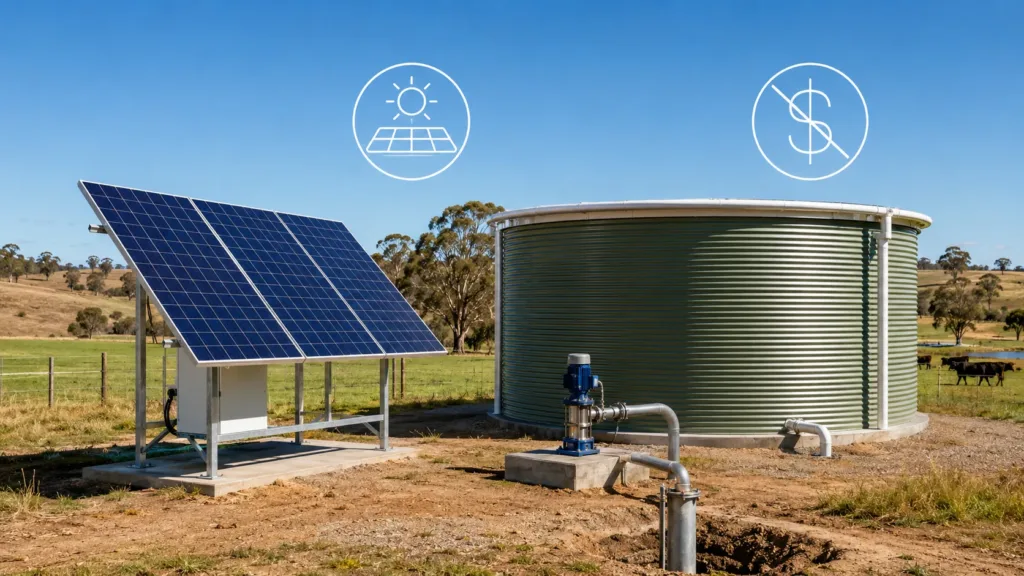
The main benefits of solar water pumps include lower dependence on diesel or grid electricity, reduced routine energy costs, practical off-grid operation, automated water delivery and flexible use with water storage.
For farms, irrigation systems, livestock operations and remote boreholes, a solar water pumping system can generate electricity close to the water source and reduce dependence on fuel delivery or long grid connections. This can be particularly useful where water demand is regular but electrical infrastructure is limited or expensive to extend.
However, solar pumping is not automatically the best solution for every project. Performance and economic value depend on required flow rate, total dynamic head (TDH), daily water demand, solar conditions, operating schedule, storage capacity and the cost of alternative power sources. This guide explains seven advantages of solar water pumps, their limitations, and how solar compares with diesel pumping.
How Does a Solar Water Pump Work?
A solar water pump uses photovoltaic panels to convert sunlight into electrical energy. A solar pump controller manages that electricity and supplies power to a submersible or surface pump, which moves water from the source to a storage tank, irrigation system, livestock trough or other point of use.
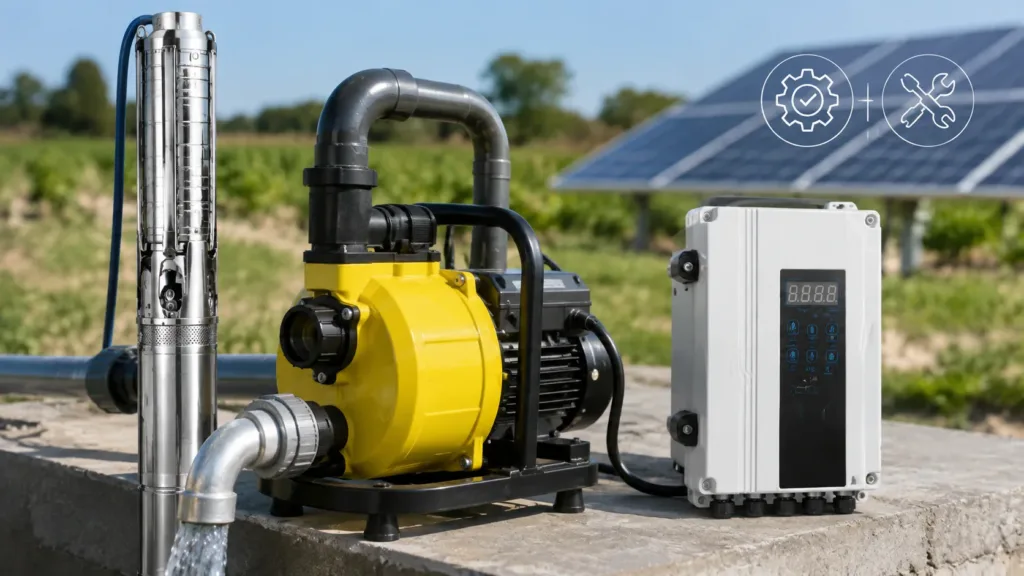
The basic process is: Sunlight → Solar Panels → MPPT Controller → Water Pump → Water Storage or Irrigation.
Solar Panels
Photovoltaic (PV) panels generate DC electricity when exposed to sunlight. Available output changes with solar irradiance, panel temperature, orientation, shading and weather conditions. The solar array therefore needs to be correctly matched to the pump controller and motor requirements.
MPPT Solar Pump Controller
An MPPT solar pump controller manages the electrical power available from the PV array and adjusts the system operating point as solar conditions change.
Depending on the controller model and system configuration, functions may include dry-run protection, low-water protection, tank-full control, water-level control, electrical protection and automatic restart.
Solar Submersible Pump or Surface Pump
A solar submersible pump operates underwater and is commonly used for wells and boreholes. A solar surface pump operates above ground and is generally used with ponds, rivers, reservoirs, canals and storage tanks where suction conditions are suitable.
Learn more about how a solar water pump system works.
1. Lower Routine Energy Costs
One of the main advantages of solar water pumps is the potential to reduce the amount of purchased energy required for water pumping.
During direct solar operation, photovoltaic panels provide the electrical energy used by the pump, reducing reliance on diesel fuel or grid electricity.
Reduced Diesel Consumption
For farms using diesel-powered water pumps, operating costs can include fuel purchases, transport, storage and engine servicing. These costs can become more significant when the pumping site is far from normal farm infrastructure.
Solar pumping can reduce diesel consumption and the need for regular fuel delivery during periods when sufficient solar energy is available.
Reduced Grid Electricity Consumption
Where grid electricity is available, solar pumping can reduce purchased electricity used for daytime applications such as irrigation and storage-tank filling.
Actual savings depend on local electricity tariffs, fuel prices, required pumping hours, hydraulic conditions, solar resource, system size and installation cost.
2. Practical for Remote and Off-Grid Water Supply
An off-grid solar water pump can be particularly useful where extending electrical infrastructure to a remote water source would be difficult or expensive.
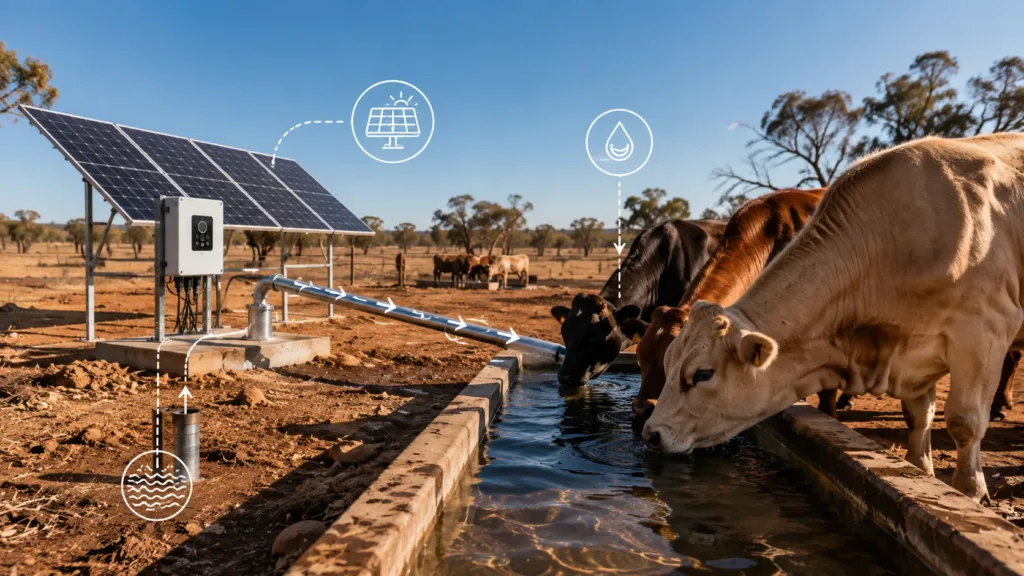
Reduce the Need for Long Grid Extensions
A solar pumping system can generate electricity close to a borehole, well, pond or other water source. This can reduce the need for long electrical runs installed solely to operate a water pump.
Solar Water Pumps for Remote Farms
Remote agricultural properties may have water sources located far from buildings and existing electrical infrastructure. Solar pumps can support distributed water points for irrigation, storage-tank filling and livestock watering when site conditions are suitable.
Solar Water Pumps for Livestock Watering
A solar water pump for livestock can move groundwater or surface water into tanks and drinking troughs. With suitable storage and water-level controls, the system can reduce the need for frequent manual operation at remote sites.
3. Lower Routine Maintenance Than Diesel Pumping
Solar pumping systems do not use an internal combustion engine during direct solar operation. This avoids several engine-related maintenance tasks associated with diesel or petrol pumping equipment.
No Combustion-Engine Servicing
Engine-driven water pumps may require oil changes, fuel-system maintenance, filters and other regular engine servicing. Solar-electric pumping avoids these combustion-engine maintenance requirements.
Solar Pump Systems Still Require Maintenance
Solar water pumps are not maintenance-free. Routine inspection may include checking and cleaning solar panels, inspecting electrical connections, checking controller status, monitoring pump performance and maintaining pipework, filters and the water source.
4. Automatic Pumping and Water-Level Control
Another practical solar water pump benefit is the ability to automate water transfer when the system uses a suitable controller and sensors.
MPPT Power Management
The controller manages changing solar input so the pump can operate according to the electrical power available from the PV array. Pump speed and water output may vary as solar conditions change.
Dry-Run Protection
Depending on the controller and sensor configuration, dry-run or low-water protection can stop the pump when insufficient source water is detected, helping reduce the risk of unsuitable dry operation.
Tank-Full and Water-Level Control
With compatible float switches or water-level sensors, the system can stop pumping when a storage tank reaches the selected level and restart when additional water is required.
Available automation functions depend on the specific controller model and system configuration.
5. Water Storage Can Reduce the Need for Batteries
Do solar water pumps need batteries? Not necessarily. Many agricultural and livestock solar pumping systems operate without electrical battery storage.
Instead of storing electricity, the system can pump water during periods of suitable solar energy and store that water in a tank or reservoir for later use.
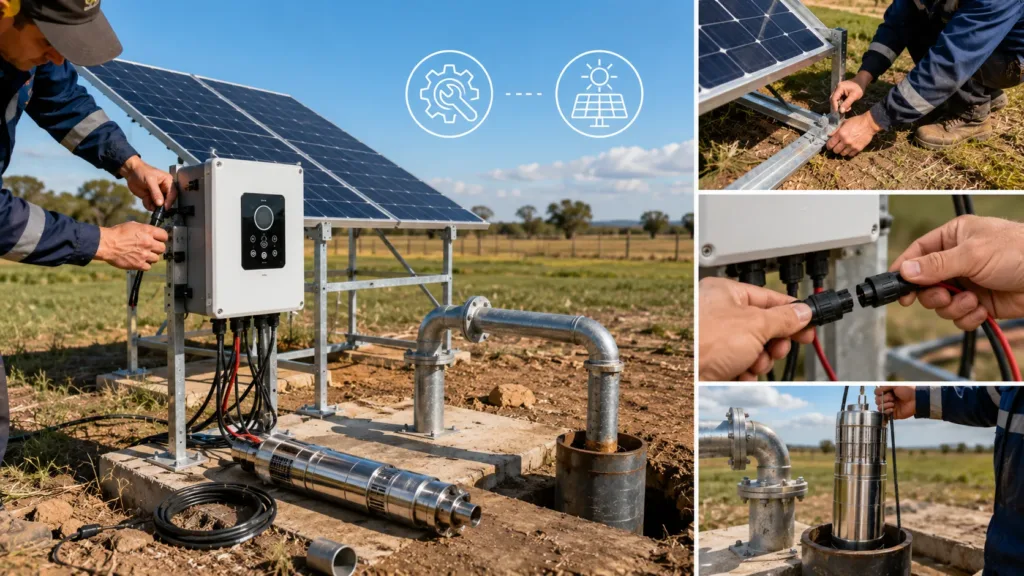
Water Storage vs Battery Storage
For applications such as irrigation and livestock watering, storing water can provide a practical alternative to storing electricity. The pump operates when sufficient solar energy is available, while stored water remains available after solar pumping decreases or stops.
When Batteries May Be Useful
Batteries may be considered when on-demand pumping is required without sufficient water storage, when continuous pressure is required, or when pumping must continue during periods with inadequate solar input.
AC/DC Hybrid Solar Pump Systems
Another option is an AC/DC hybrid solar pump system. Depending on controller design, solar power can remain the primary energy source while grid electricity or a generator provides backup during periods of low solar input or at night.
Solar Pump Project Help
Considering Solar for a Remote Water Source?
Share your water source, required flow, total dynamic head, daily water demand and current power source. Our team can help evaluate whether a solar pumping configuration fits your project.
6. Suitable for Irrigation, Livestock Watering and Deep Wells
Solar pumping technology can be configured for a wide range of agricultural water applications when the pump, controller and PV array are correctly matched to the hydraulic requirements.
Solar Water Pump for Irrigation
A solar irrigation pump can supply drip irrigation, sprinkler systems, greenhouse watering, field irrigation and storage tanks.
Correct selection depends on both required flow rate and the pressure or total head required by the irrigation network.
Solar Water Pump for Livestock
Solar pumping can supply storage tanks and livestock troughs in remote paddocks or grazing areas. Required system capacity should be based on animal numbers, daily water consumption, storage capacity and seasonal demand.
Solar Water Pump for Deep Wells and Boreholes
A solar submersible pump can be used for deep wells and boreholes when it is selected for the required hydraulic duty.
Important parameters include required flow rate, total dynamic head (TDH), static water level, dynamic water level, delivery elevation, pipe friction, borehole diameter and daily water demand. Well depth alone should not be used as the required pump head.
Learn how to size a solar water pump for your farm.
7. Lower On-Site Emissions and Operating Noise Than Diesel Pumping
Solar-electric pumping can also reduce some of the local environmental and operational impacts associated with fuel-powered pumping.
Reduced Local Exhaust
During direct solar operation, no diesel or petrol is burned at the pumping site. This means there are no direct fuel-combustion exhaust emissions from the pump’s energy source during that period.
This does not mean the complete solar system has zero lifecycle environmental impact, because manufacturing, transportation, installation and eventual component replacement also have environmental impacts.
Lower Operating Noise
Electric solar pumping equipment generally operates more quietly than an engine-driven diesel pumping system, although actual noise depends on pump type, installation and surrounding equipment.
Solar Water Pump vs Diesel Pump
When comparing a solar water pump vs diesel pump, the better option depends on water demand, location, available energy sources, operating schedule, fuel access and project economics.
| Factor | Solar Water Pump | Diesel Pump |
|---|---|---|
| Primary Energy Source | Solar energy | Diesel fuel |
| Fuel Delivery | Not required during direct solar operation | Regular fuel supply required |
| Engine Maintenance | No combustion engine | Engine servicing required |
| Remote Applications | Well suited where solar conditions and system design are suitable | Depends on reliable fuel access |
| Dependence on Sunlight | Direct solar output varies with available sunlight | Independent of sunlight while fuel is available |
| Night Pumping | Requires stored water, batteries or backup power when pumping is needed | Can operate while fuel is available |
| Initial Investment | May be higher because of PV and controller components | A basic engine-pump setup may have lower upfront equipment cost |
| Routine Energy Cost | Potentially lower during solar operation | Ongoing fuel expenditure |
What Are the Disadvantages and Limitations of Solar Water Pumps?
Understanding both the advantages and disadvantages of solar water pumps is important before selecting a system. Solar pumping can provide strong benefits, but system performance depends on correct engineering and actual site conditions.
Solar Output Changes With Weather and Time of Day
Available solar power changes throughout the day and can be reduced by cloud cover, shading, seasonal conditions and high panel temperatures. In a direct solar system, these changes can affect pump speed and water output.
Correct Pump Sizing Is Essential
Solar water pump sizing should be based on actual hydraulic requirements rather than horsepower alone.
Important parameters include required flow rate, total dynamic head, static and dynamic water levels, delivery elevation, pipe friction, daily water demand and available solar energy.
Initial Investment Can Be Higher
A complete solar pumping system may require photovoltaic panels, a controller, pump, mounting structure, electrical cables, pipework and installation. This can create a higher initial investment than purchasing a basic standalone fuel-powered pump.
Night Pumping Requires Planning
A direct solar water pump does not receive solar energy after sunset. If pumping must continue at night, the project may require water storage, batteries, grid backup, generator backup or an appropriate hybrid configuration.
When Does a Solar Water Pump Make the Most Sense?
Solar pumping is especially worth evaluating when:
- The water source is far from reliable grid electricity.
- Extending grid power would be expensive or difficult.
- Diesel fuel or fuel delivery is expensive or inconvenient.
- The project has regular daytime water demand.
- A suitable storage tank or reservoir can be installed.
- The site has adequate solar exposure.
- Automatic remote pumping would reduce routine manual operation.
- The application involves irrigation, livestock watering, wells, boreholes or remote water storage.
Is a Solar Water Pump Worth It?
A solar water pump can be a strong long-term option when a project has regular water demand, suitable solar conditions and relatively high diesel, electricity or grid-extension costs.
It can be particularly attractive for remote agricultural water supply where daytime pumping can be combined with water storage.
However, there is no universal payback period. Project economics depend on required flow, TDH, pumping hours, solar array size, storage capacity, installation cost, maintenance requirements and the cost of alternative energy sources. A project-specific comparison provides a more reliable answer than a general ROI claim.
Frequently Asked Questions About Solar Water Pump Benefits
What are the main benefits of solar water pumps?
The main benefits include reduced dependence on purchased fuel or grid electricity, lower routine energy costs during solar operation, suitability for remote and off-grid locations, automated operation, reduced combustion-engine maintenance and the ability to combine daytime pumping with water storage.
What are the disadvantages of solar water pumps?
Common limitations include variable solar input, the need for correct pump and PV sizing, potentially higher initial investment, and the need for storage or backup power when water must be pumped without sufficient sunlight.
Are solar water pumps worth it for farms?
They can be, particularly for farms with remote water sources, regular daytime water demand or high fuel and grid-extension costs. Suitability depends on required flow, total dynamic head, daily water demand, solar resource and the cost of alternative power.
Is a solar water pump cheaper than a diesel pump?
A solar system may have a higher initial investment but can reduce recurring fuel expenditure and engine-related maintenance. Whether it is cheaper over the life of the project depends on local fuel prices, pumping requirements, installation costs and operating conditions.
Do solar water pumps need batteries?
Not necessarily. Many agricultural solar pumping systems use a water storage tank instead of electrical battery storage. Batteries may be useful when pumping itself must continue without sufficient solar input and stored water cannot meet demand.
Can a solar water pump work at night?
A direct solar pump does not receive solar energy at night. Nighttime water demand can be served from a storage tank, or pumping can continue using batteries or a suitable grid, generator or hybrid backup system.
Do solar water pumps work on cloudy days?
A solar pump may continue operating when enough solar energy is available, but available power and water output can decrease under low irradiance. Actual performance depends on the pump, controller, PV array, system head and weather conditions.
Are solar water pumps good for irrigation?
Solar water pumps can be used for drip irrigation, sprinkler systems, greenhouse irrigation, field irrigation and storage-tank filling. The system must be selected for the required flow, pressure, TDH, daily water demand and available solar energy.
Can solar pumps be used for deep wells?
Yes. Solar submersible pumps can be used in deep wells and boreholes when the selected pump can provide the required flow at the project’s actual total dynamic head. Well depth alone is not sufficient for pump selection.
How much maintenance does a solar water pump need?
Routine requirements vary by installation, but may include inspecting and cleaning solar panels, checking electrical connections and controllers, monitoring pump performance and maintaining filters, pipework and the water source.
How do I choose the right solar water pump?
Start with required daily water volume, required flow rate and total dynamic head. Then consider static and dynamic water levels, pipe diameter and length, water source, application, operating schedule, controller requirements and available solar conditions.
Solar Pump Selection
Need Help Selecting a Solar Water Pump for Your Project?
Send us your water source, well depth, static and dynamic water levels, required flow, total dynamic head, daily water demand and available power source. Our team can help identify a suitable pump, controller and solar configuration.