
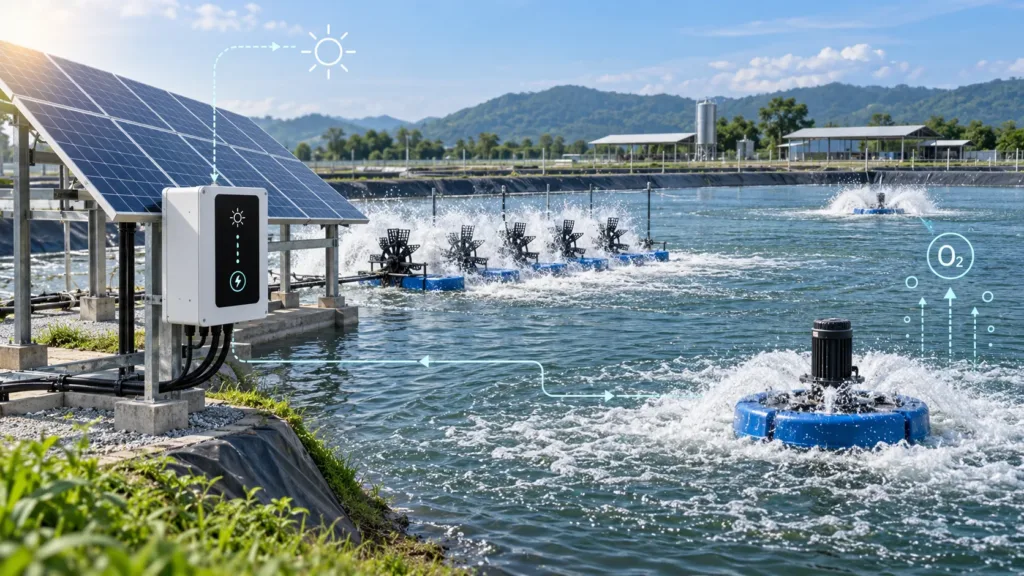
How do you size a solar aerator for a fish pond? Calculate pond volume, estimate peak fish biomass, measure dissolved oxygen during critical periods, evaluate both immediate and ongoing oxygen demand, and compare those requirements with verified aerator performance. Then determine aerator quantity, placement, operating time and the solar or backup power required for the actual production schedule.
Correct solar aerator sizing requires more than matching motor horsepower to pond area. Two ponds with the same surface area can require very different aeration capacity because depth, peak biomass, stocking density, feed load, dissolved oxygen conditions and production intensity all affect the real oxygen requirement.
For commercial fish farming, shrimp farming and off-grid aquaculture, an undersized aeration system may leave insufficient oxygen during critical periods. An oversized system can increase equipment and solar-system cost without providing a proportional improvement in pond performance.
Quick Solar Aerator Sizing Sequence
Pond Area & Depth → Pond Volume → Peak Fish Biomass → Stocking Density & Feed Rate → Dissolved Oxygen → Immediate Oxygen Deficit → Ongoing Oxygen Demand → Aerator Performance → Aerator Type → Quantity & Placement → Operating Hours → Solar Array → Backup Strategy
Key principle: pond area describes the size of the water body, but it does not define the complete oxygen demand.
The 4 Main Factors That Determine Aerator Size
| Design Factor | Why It Matters |
|---|---|
| Pond volume | Shows how much water must be circulated and oxygenated. |
| Peak fish biomass | Higher biomass generally creates greater biological oxygen demand. |
| Dissolved oxygen conditions | Shows whether the pond is approaching critical oxygen levels. |
| Aerator oxygen-transfer performance | Determines how effectively the equipment can transfer oxygen under defined conditions. |
Motor horsepower alone does not provide enough information to size a commercial fish pond aerator.
What Information Do You Need Before Sizing a Solar Aerator?
| Project Data | Why It Matters |
|---|---|
| Pond area | Defines the surface area of the production pond. |
| Average water depth | Used with surface area to calculate pond volume. |
| Fish or shrimp species | Species and life stage influence oxygen demand and acceptable DO conditions. |
| Current and expected peak biomass | Peak biomass is often more important than stocking-day biomass. |
| Stocking density | Higher production intensity usually increases aeration demand. |
| Daily feed rate | Feed input can increase biological and microbial oxygen demand. |
| Dissolved oxygen readings | Shows actual oxygen conditions, particularly overnight and near dawn. |
| Water temperature | Influences biological activity and oxygen conditions. |
| Required operating hours | Determines electrical-energy and solar-system requirements. |
| Nighttime backup requirement | Important because critical DO may occur when solar power is unavailable. |
Based on our experience manufacturing solar aeration and off-grid water systems, pond dimensions alone rarely provide enough information for reliable equipment selection. Fish biomass, feed load, dissolved oxygen conditions and operating schedule are equally important.
For a broader overview of available equipment and applications, see our solar aerator systems for aquaculture and fish farming.
Step 1: Measure Pond Area and Average Depth
Start with the physical dimensions of the pond.
For a rectangular pond:
Pond Area = Length × Width
For irregular ponds, divide the pond into smaller measurable sections or use site-survey or mapping data to estimate the total surface area.
Average depth is more useful than maximum depth alone because it provides a better estimate of the total water volume that must be circulated and aerated.
Step 2: Calculate Pond Volume
A simplified pond-volume calculation is:
Pond Volume = Pond Area × Average Depth
Example
- Pond surface area: 2,000 m²
- Average depth: 1.5 m
2,000 × 1.5 = 3,000 m³
The pond therefore contains approximately 3,000 m³ of water.
This is an important starting point, but pond volume alone still does not determine the final aeration requirement.
Step 3: Estimate Current and Peak Fish Biomass
Total fish biomass can be estimated using:
Total Biomass = Number of Fish × Average Fish Weight
Example
If a pond contains 10,000 fish with an average weight of 0.5 kg:
10,000 × 0.5 kg = 5,000 kg of fish biomass
A pond carrying 5,000 kg of biomass generally places a much greater biological oxygen load on the water than the same pond carrying only 1,000 kg.
Size for Expected Peak Biomass
For grow-out ponds, current biomass can be much lower than biomass shortly before harvest.
If the aeration system must support the full production cycle, sizing should consider the expected peak biomass, not only the fish weight at stocking.
As fish grow, respiration and feed consumption can increase substantially. A system sized only for early-stage production may become inadequate later in the cycle.
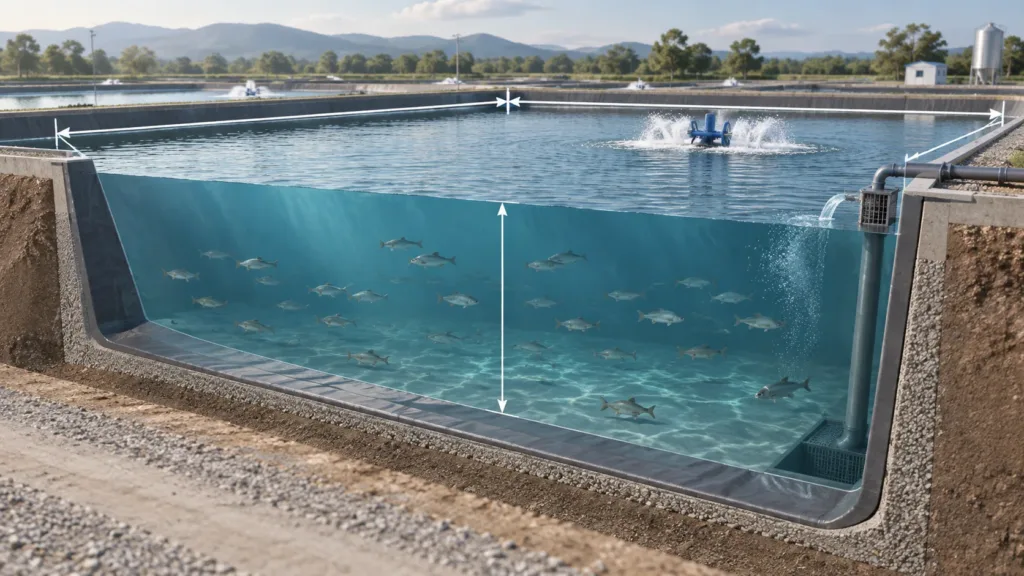
Figure: Pond volume defines the water body, while peak biomass helps define the biological oxygen load.
Figure: Pond volume defines the water body, while peak biomass helps define the biological oxygen load.
Step 4: Consider Stocking Density and Feed Rate
Stocking density and feeding intensity are closely related to the biological load in a commercial pond.
Higher production intensity can lead to:
- More fish or shrimp respiration
- Higher feed input
- More organic waste
- Greater microbial activity
- Higher sediment oxygen demand
This is why two farms growing the same species in ponds of the same size can still require different aeration systems.
Step 5: Measure Dissolved Oxygen Through the Daily Cycle
Dissolved oxygen (DO) is one of the most important measurements in fish pond aerator sizing.
A single daytime reading is not enough because dissolved oxygen can change significantly over a 24-hour period.
Why Afternoon DO Can Be Misleading
During daylight, algae and aquatic plants can produce oxygen through photosynthesis. Afternoon DO may therefore appear healthy even when the pond experiences much lower oxygen later at night.
Why Early-Morning DO Matters
After sunset, photosynthesis stops while fish, plants and microorganisms continue consuming oxygen.
DO can therefore decline throughout the night and may reach one of its lowest levels near dawn.
For commercial aquaculture, overnight and early-morning DO readings are particularly useful when evaluating aeration risk.
Do Not Use One Universal DO Target
The appropriate dissolved oxygen target depends on species, life stage, stocking density, production intensity, water temperature, salinity and farm-management objectives.
Any target value used in an example should therefore be treated as a calculation example rather than a universal requirement for every fish or shrimp farm.
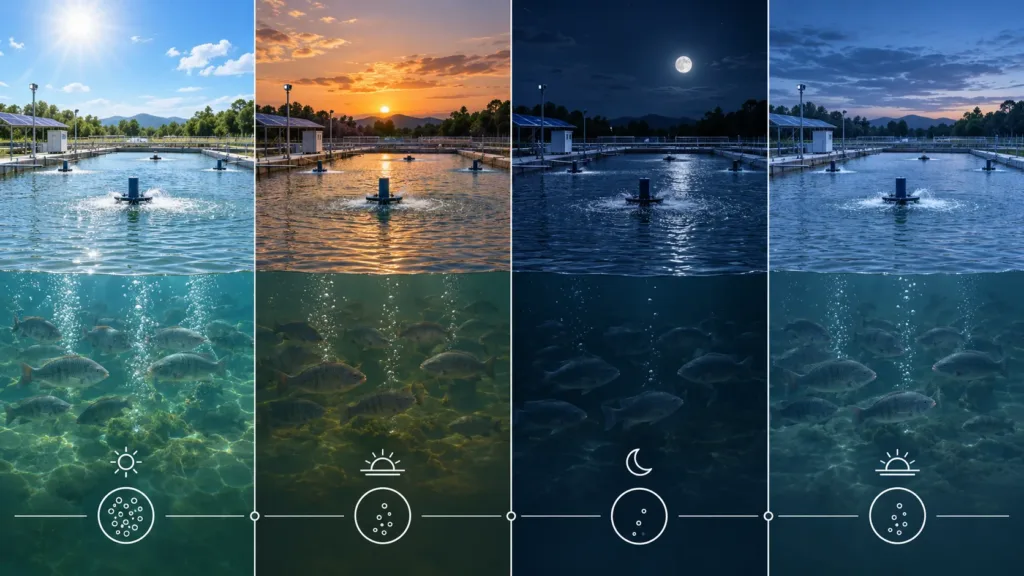
Figure: Dissolved oxygen can decline overnight and may approach its daily low point near dawn.
Figure: Dissolved oxygen can decline overnight and may approach its daily low point near dawn.
Step 6: Calculate the Immediate Oxygen Deficit
If pond volume and dissolved oxygen are known, an approximate immediate oxygen deficit can be calculated.
Oxygen Deficit (kg O₂) = Pond Volume (m³) × Required DO Increase (mg/L) ÷ 1,000
Example
- Pond volume: 3,000 m³
- Measured DO: 3.5 mg/L
- Example target DO: 5.0 mg/L
The required increase is:
5.0 − 3.5 = 1.5 mg/L
The approximate immediate oxygen deficit is:
3,000 × 1.5 ÷ 1,000 = 4.5 kg O₂
Important: this 4.5 kg value represents only the approximate oxygen required to increase the water-column DO by 1.5 mg/L at that moment.
It is not the pond’s total daily oxygen demand.
Step 7: Estimate Ongoing Biological Oxygen Demand
The pond continues consuming oxygen even after the immediate DO deficit has been corrected.
Ongoing oxygen demand can be influenced by:
- Fish or shrimp respiration
- Total biomass
- Species and life stage
- Stocking density
- Daily feed rate
- Water temperature
- Organic loading
- Microbial decomposition
- Sediment oxygen demand
- Plant and phytoplankton respiration at night
Because these factors vary greatly between ponds, there is no reliable universal rule such as one horsepower of aeration for every fixed pond area.
Why a Fixed HP-per-Acre Rule Is Not Enough
A commercial pond needs enough effective aeration to cover oxygen demand under its real biological load and operating conditions while also providing useful circulation and appropriate redundancy. This is why a single horsepower-per-acre rule is not reliable for all intensive fish or shrimp ponds.
Step 8: Check the Aerator’s Oxygen Transfer Performance
After evaluating pond oxygen demand, compare the requirement with verified performance data for the selected aerator.
Useful technical parameters may include:
- SOTR — Standard Oxygen Transfer Rate: the quantity of oxygen transferred per unit of time under defined standard test conditions.
- SAE — Standard Aeration Efficiency: oxygen transfer relative to electrical-energy consumption under standard conditions.
- Oxygen transfer capacity
- Water circulation capacity
- Motor power
- Airflow and diffuser performance for diffused-air systems
Motor horsepower is not the same as oxygen-transfer capacity.
Two aerators with the same motor power can perform differently because of paddle geometry, impeller design, airflow, operating depth, diffuser characteristics and mechanical efficiency.
SOTR vs Actual Pond Performance
Standard oxygen-transfer figures are measured under defined test conditions.
Actual field performance can vary with:
- Water temperature
- Existing dissolved oxygen concentration
- Salinity
- Pond depth
- Water quality
- Organic load
- Aerator position
Laboratory performance values should therefore be interpreted together with actual pond conditions.
Fish Pond Aerator Sizing Support
Know Your Pond Size and Biomass? Let Us Check the Aeration Requirement.
Send us your pond area, average depth, fish or shrimp species, expected peak biomass, stocking density, feed rate, dissolved oxygen readings, water temperature and required operating hours. We can help evaluate the aerator type, quantity, placement and solar power configuration.
Step 9: Choose the Right Aerator Type
Paddle-Wheel Aerators
Paddle-wheel aerators create strong surface agitation and horizontal circulation. They are commonly used in intensive fish and shrimp farming where both oxygen transfer and water movement are important.
Floating Surface Aerators
Floating surface aerators provide localized oxygenation and circulation and can be repositioned according to pond layout and production requirements.
Fountain Aerators
Fountain-type systems lift water above the surface and return it to the pond, increasing air-water contact while creating vertical and surface circulation.
Diffused-Air Aeration
Air pumps or blowers deliver air through submerged diffusers. Their performance depends on airflow, diffuser design, diffuser depth and system layout.
Airflow in CFM or m³/h is particularly relevant to blower and diffuser systems. It should not be used as the primary sizing parameter for paddle-wheel, floating or fountain aerators.
For solar-powered aquaculture projects, practical equipment options can include paddle-wheel aerators, floating surface aerators, fountain-type aerators and other pond oxygenation systems. Paddle-wheel units are often selected where strong horizontal circulation is important, while floating or fountain-style equipment can be useful where flexible placement or localized circulation is needed.
The final configuration should still be selected from required oxygen transfer, circulation pattern, pond layout, operating hours and redundancy needs rather than aerator type or motor power alone. Depending on the exact equipment and controller, solar operation may also support MPPT control or AC/DC hybrid backup. Controller functions and backup compatibility should be verified for the specific system supplied.
Step 10: Determine How Many Aerators Are Required
Once the required oxygen-transfer capacity and realistic field performance of one aerator are known, the approximate number of units can be evaluated.
Conceptually:
Number of Aerators = Required Oxygen Transfer ÷ Effective Oxygen Transfer per Aerator
The effective value should reflect actual pond conditions rather than relying only on a laboratory maximum.
The final number should also consider pond geometry, circulation and operational redundancy.
In large commercial ponds, several correctly positioned aerators may provide better circulation and greater operational resilience than concentrating the same total motor power in one large unit.
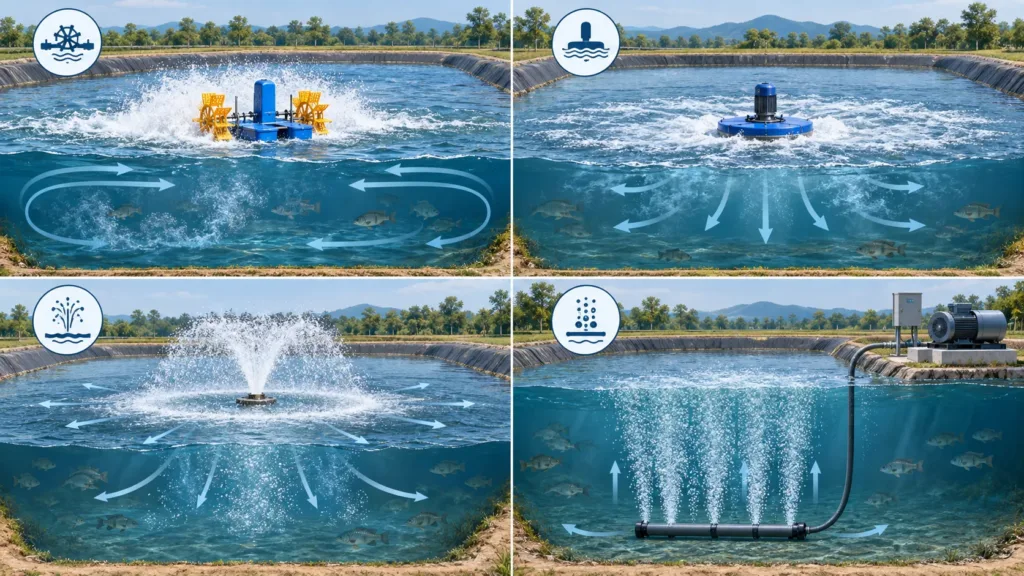
Figure: Aerator quantity should be based on required oxygen transfer and effective field performance, not motor horsepower alone.
Figure: Aerator quantity should be based on required oxygen transfer and effective field performance, not motor horsepower alone.
Step 11: Plan Aerator Placement and Pond Circulation
Installed motor power alone does not guarantee good oxygen distribution.
Aerator placement should consider:
- Pond shape
- Average and local water depth
- Water inlet and outlet locations
- Feeding areas
- High-biomass zones
- Low-circulation or dead zones
- Existing circulation direction
- Sediment accumulation areas
The goal is to combine oxygen transfer with useful water circulation so oxygenated water is distributed throughout the production area rather than concentrated around one machine.
Step 12: Determine Required Operating Hours
Aerator operating time should follow the pond’s actual oxygen cycle rather than one universal daily schedule.
Important questions include:
- When does DO begin to decline?
- What is the lowest early-morning DO?
- When is feeding performed?
- What is the expected peak biomass?
- Does aeration need to continue after sunset?
- Is emergency aeration required?
Low-density ponds may need supplemental aeration only during critical periods, while intensive aquaculture can require longer operating hours and greater redundancy.
Step 13: Match the Solar Array and Controller
Only after aerator capacity and operating schedule are established should the solar power system be finalized.
Estimate Daily Aeration Energy
A useful starting estimate is:
Daily Aeration Energy ≈ Aerator Power × Operating Time
This is only a starting energy estimate. Final PV sizing must also account for controller limits, PV voltage, temperature, irradiance, seasonal variation and system losses.
If several aerators operate simultaneously, use their combined electrical load.
Final solar design should also consider:
- Aerator rated power
- Motor operating voltage
- Controller input voltage range
- Controller maximum input voltage
- PV module Vmp
- PV module Voc
- Temperature effects on PV voltage
- Local solar irradiance
- Seasonal solar variation
- Required operating hours
There is no universal number of solar panels for every fish pond aerator.
Panel quantity and series/parallel configuration depend on the specific aerator, controller, PV modules, climate and operating requirements.
Step 14: Evaluate Nighttime and Cloudy-Weather Risk
This is one of the most important differences between solar aeration and many solar water-pumping applications.
The period of lowest dissolved oxygen may occur late at night or shortly before sunrise, when direct solar power is unavailable.
Direct Daytime Solar Aeration
Daytime-only solar aeration may be suitable where daytime circulation and oxygenation are sufficient and overnight DO remains within the farm’s acceptable range.
Solar Plus Battery
Battery storage may be considered when aeration must continue after sunset and electrical energy needs to be stored for nighttime operation.
Battery capacity should be calculated from the actual aerator load, required backup runtime, system voltage, battery chemistry and allowable depth of discharge rather than from a universal amp-hour value.
AC/DC Hybrid Aeration
Where supported by the aerator and controller, solar energy can provide primary daytime power while grid electricity or a generator provides backup during low-solar conditions or at night.
Cloudy Weather Can Create a Double Constraint
Extended cloudy conditions can create two simultaneous challenges. Less sunlight may reduce electrical power available to the aeration system, while reduced sunlight can also reduce photosynthetic oxygen production in the pond.
This does not mean every solar aeration system requires batteries. However, high-density aquaculture projects should evaluate prolonged cloudy weather and nighttime oxygen risk when deciding whether backup power is required.
Consider Emergency Aeration and Redundancy
For high-density commercial aquaculture, system planning should also consider what happens if one aerator, controller or power source becomes unavailable.
Where oxygen loss could create significant production risk, multiple aerators or an independent backup source can provide greater operational resilience than relying entirely on one large aerator.
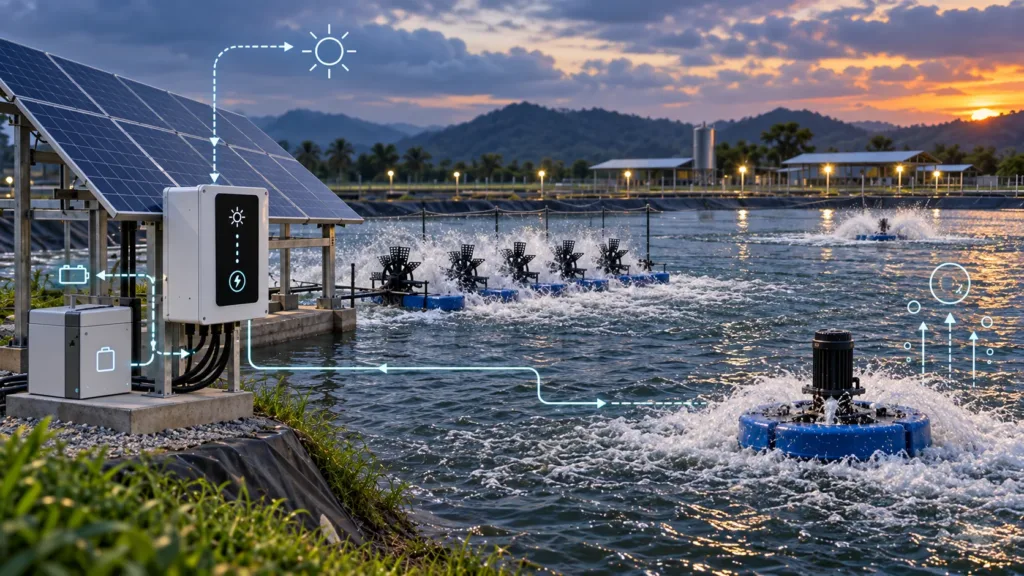
Figure: Nighttime aeration requires stored energy or another suitable backup source when direct solar power is unavailable.
Figure: Nighttime aeration requires stored energy or another suitable backup source when direct solar power is unavailable.
Complete Solar Aerator Sizing Example
Consider a preliminary fish pond project with:
| Design Item | Example Value |
|---|---|
| Pond area | 2,000 m² |
| Average depth | 1.5 m |
| Pond volume | 3,000 m³ |
| Fish count | 10,000 |
| Average fish weight | 0.5 kg |
| Example fish biomass | 5,000 kg |
| Measured low DO | 3.5 mg/L |
| Example target DO | 5.0 mg/L |
1. Calculate Pond Volume
2,000 × 1.5 = 3,000 m³
2. Calculate the Immediate DO Difference
5.0 − 3.5 = 1.5 mg/L
3. Calculate the Immediate Oxygen Deficit
3,000 × 1.5 ÷ 1,000 = 4.5 kg O₂
4. Check Biomass and Peak-Biomass Risk
The illustrative current biomass is 10,000 × 0.5 = 5,000 kg. If expected harvest-stage biomass will be higher, use that peak value when evaluating the final aeration system.
5. Add Ongoing Biological Oxygen Demand
Evaluate fish respiration, feed input, microorganisms, sediment activity and other oxygen-consuming processes.
6. Check Aerator Performance
Compare the estimated requirement with verified SOTR, SAE or other relevant performance data for the selected aerator.
7. Determine Aerator Quantity and Placement
Select the number and location of units required to provide useful oxygen distribution and circulation.
8. Define the Operating Schedule
Review the full daily DO cycle, especially nighttime and early-morning conditions.
9. Match the Solar System
Use aerator electrical load and required operating hours as the starting point for controller and PV-array design.
10. Evaluate Backup Requirements
Consider batteries, AC/grid power, generator backup or redundant aeration where the production risk justifies it.
Important: this example demonstrates the sizing method. It does not recommend a specific horsepower or number of aerators. Final selection should use actual pond-production data and verified equipment performance.
Common Solar Aerator Sizing Mistakes
Sizing Only by Pond Area
Pond area does not account for water depth, biomass, feed load or dissolved oxygen conditions.
Selecting by Horsepower Alone
Motor power does not directly show how much oxygen the aerator can transfer into the pond.
Using Current Biomass Instead of Peak Biomass
A system sized early in the grow-out cycle may become insufficient as fish grow and feed consumption increases.
Measuring DO Only in the Afternoon
Afternoon DO can hide critical overnight or pre-dawn oxygen conditions.
Treating Immediate Oxygen Deficit as Daily Oxygen Demand
The water-column deficit is only one part of total pond oxygen demand.
Assuming Laboratory SOTR Equals Field Performance
Actual oxygen transfer can vary with temperature, salinity, existing DO, pond depth, water quality and aerator placement.
Ignoring Aerator Placement
Poor placement can create low-circulation zones even when total installed motor power appears sufficient.
Ignoring Nighttime and Cloudy-Weather Risk
Critical oxygen demand and maximum solar generation do not necessarily occur at the same time.
Using a Fixed Number of Solar Panels
PV requirements depend on aerator load, controller limits, PV-module specifications, climate and required operating time.
Solar Aerator Sizing Checklist
- Pond area
- Average water depth
- Fish or shrimp species
- Fish count
- Average current weight
- Expected peak biomass
- Stocking density
- Daily feed rate
- Daytime DO
- Lowest overnight or early-morning DO
- Water temperature
- Existing aeration equipment
- Required operating hours
- Local solar conditions
- Nighttime or emergency backup requirement
Frequently Asked Questions About Solar Aerator Sizing
How do I size a solar aerator for a fish pond?
Calculate pond volume, estimate peak fish biomass, measure dissolved oxygen, evaluate ongoing oxygen demand and compare those requirements with verified aerator performance before sizing the solar power system.
Can I size a fish pond aerator by pond area?
Pond area is useful as an initial measurement, but it is not sufficient by itself. Depth, biomass, feeding intensity and dissolved oxygen conditions can significantly change aeration demand.
How much aeration does a fish pond need?
There is no universal value for every pond. For sizing, use pond volume, peak biomass, dissolved oxygen conditions, ongoing biological oxygen demand and verified aerator performance rather than a fixed horsepower-per-area rule.
What is SOTR in pond aeration?
SOTR, or Standard Oxygen Transfer Rate, describes oxygen transfer under defined standard test conditions. Actual oxygen transfer in a fish pond may differ from the standard value.
What is SAE in aeration?
SAE, or Standard Aeration Efficiency, relates standard oxygen transfer to electrical-energy consumption under defined conditions.
Does CFM determine fish pond aerator size?
CFM is mainly relevant to blower and diffused-air systems. Paddle-wheel, floating and fountain aerators should not be selected by airflow alone.
How many solar aerators does a fish pond need?
The number depends on total oxygen demand, effective aerator performance, pond geometry, circulation requirements and desired redundancy.
Can a solar aerator operate at night?
A direct solar aerator depends on available sunlight. Nighttime operation requires suitable energy storage or another backup source, or an AC/DC hybrid configuration where supported.
Which type of aerator is best for fish farming?
The best type depends on production intensity, pond depth, circulation requirements and operating conditions. Paddle-wheel, floating surface, fountain and diffused-air systems each have different characteristics.
What information should I send an aerator supplier?
Provide pond dimensions, average depth, species, current and expected peak biomass, stocking density, feed rate, dissolved oxygen measurements, water temperature, operating schedule and available solar or backup-power conditions.
Aquaculture Aeration Selection
Need Help Matching Oxygen Demand, Aerator Capacity and Solar Power?
Send us your pond area, average depth, species, expected peak biomass, feed rate, dissolved oxygen conditions, operating schedule and nighttime backup requirement. We can help evaluate the aerator type, quantity, placement, controller, solar configuration and backup strategy for your aquaculture project.