
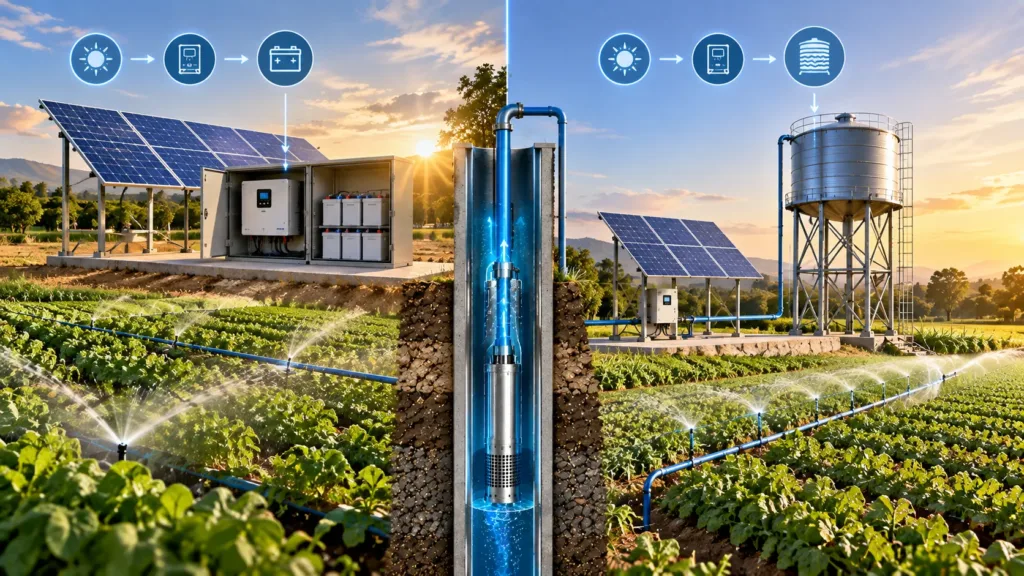
Most solar water pumps do not inherently require batteries. A compatible pump and controller can often use solar power directly during daylight and store the pumped water in a tank for later use. Batteries may be useful when the pump itself must operate without sufficient sunlight or when night-time pressure cannot be provided by gravity, a pressure vessel, a separate booster arrangement, or an approved AC/DC backup source.
The correct choice depends on daily water demand, required flow and pressure, total dynamic head, water-source yield, local solar conditions, available storage space, and the exact pump and controller design. In many irrigation and livestock projects, storing water is simpler than storing electricity. In pressure-sensitive or time-critical applications, batteries or another backup source may be justified.
How Can a Solar Water Pump Work Without Batteries?
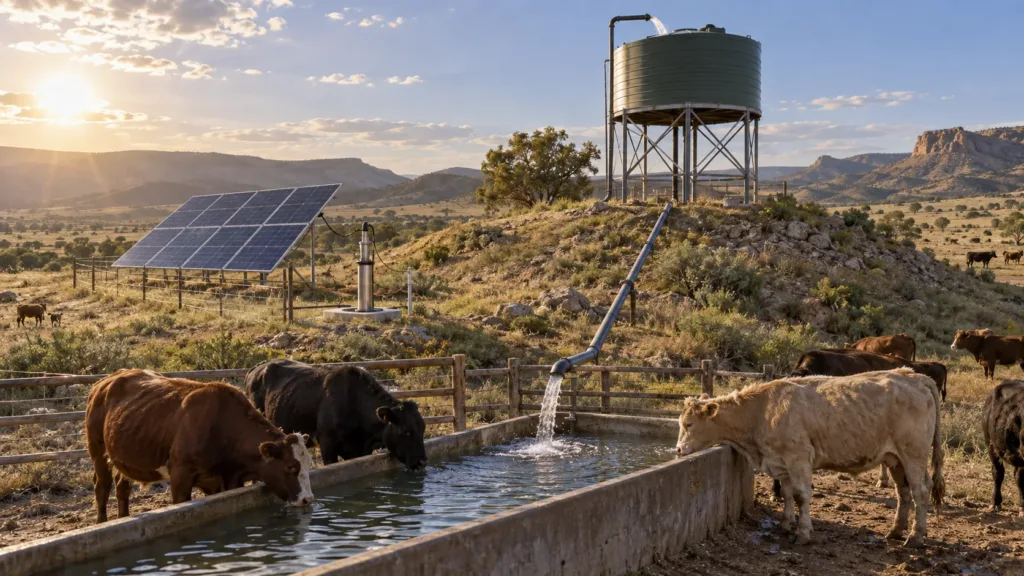
In a direct solar pumping system, the photovoltaic array supplies power to a compatible solar pump controller, which operates the pump when adequate solar energy is available. The pump transfers water from a well, borehole, pond, or other source into a storage tank. When solar input falls below the controller’s operating threshold, the pump stops, but the stored water can remain available for later use.
Where supported by the specific controller, maximum power point tracking helps the system use available PV power as irradiance changes. A solar pump controller is not the same as a battery charge controller, and an arbitrary pump should never be connected directly to PV modules. Array voltage, current, and power must remain within the verified limits of the selected pump and controller. For a component-level explanation, read our guide to how a solar water pump works.
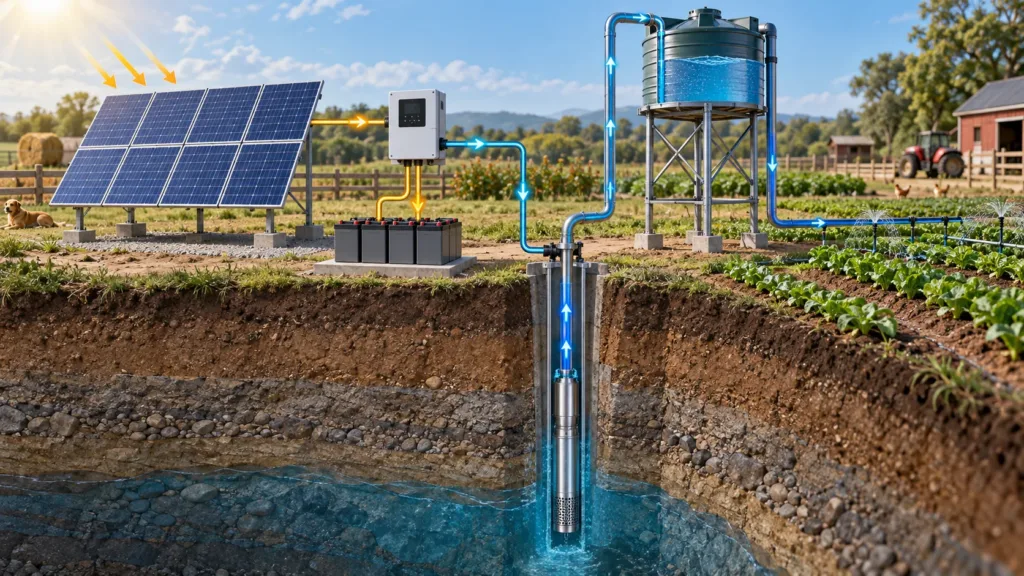
Pump speed, flow, and operating time can change with irradiance, array design, temperature, hydraulic load, and controller limits. This is often manageable when the design target is reliable daily water volume rather than constant instantaneous flow. Applications requiring stable pressure or pumping independent of sunlight need an appropriately designed storage, booster, battery, grid, or generator-supported solution.
Water Tank vs. Battery Storage for a Solar Pump
The main engineering question is whether the project should store pumped water or electrical energy. Neither option is universally better. The right architecture depends on how much water is needed, when it is needed, what pressure is required, and what maintenance resources are available at the site.
| Decision Factor | Water Storage Tank | Battery Storage |
|---|---|---|
| What is stored? | Pumped water | Electrical energy |
| Typical fit | Water demand that can be separated from pumping time | Pump or booster operation when solar input is unavailable |
| Pressure | Depends on tank elevation, distribution losses, and any booster arrangement | Can power compatible pumping equipment, subject to battery, controller, and inverter design |
| System complexity | Usually fewer electrical-storage components | Requires compatible charging, protection, control, and power-conversion components |
| Maintenance | Tank hygiene, structure, valves, float controls, overflow, and leakage checks | Battery condition, temperature, protection, connections, charging performance, and replacement planning |
| Main sizing input | Daily water demand, refill pattern, and required reserve period | Electrical load, run time, starting behaviour, usable capacity, autonomy, and charging conditions |
| Key constraints | Space, elevation, water quality, structural requirements, and usable pressure | Added components, conversion losses, thermal conditions, finite cycle life, and compatibility |
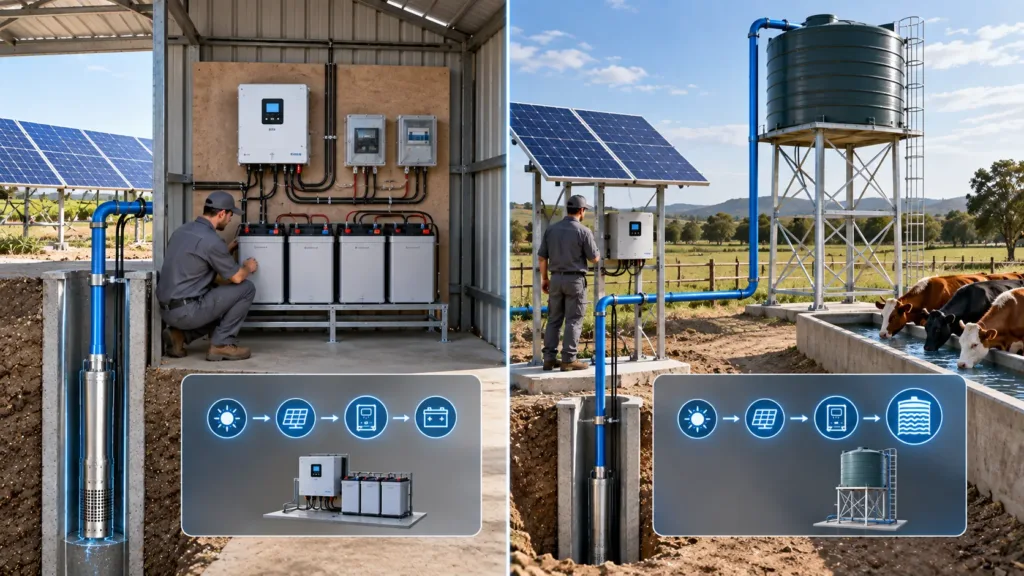
For irrigation, livestock watering, and many remote water-supply projects, a tank can separate pumping time from consumption time without adding an electrical battery bank. A battery becomes more relevant when the pump or pressure booster must run after dark, when storage space is limited, or when the operating schedule cannot follow solar availability. Compare the complete installed and lifecycle system rather than one component price.
When Is a Water Storage Tank Usually the Better Choice?
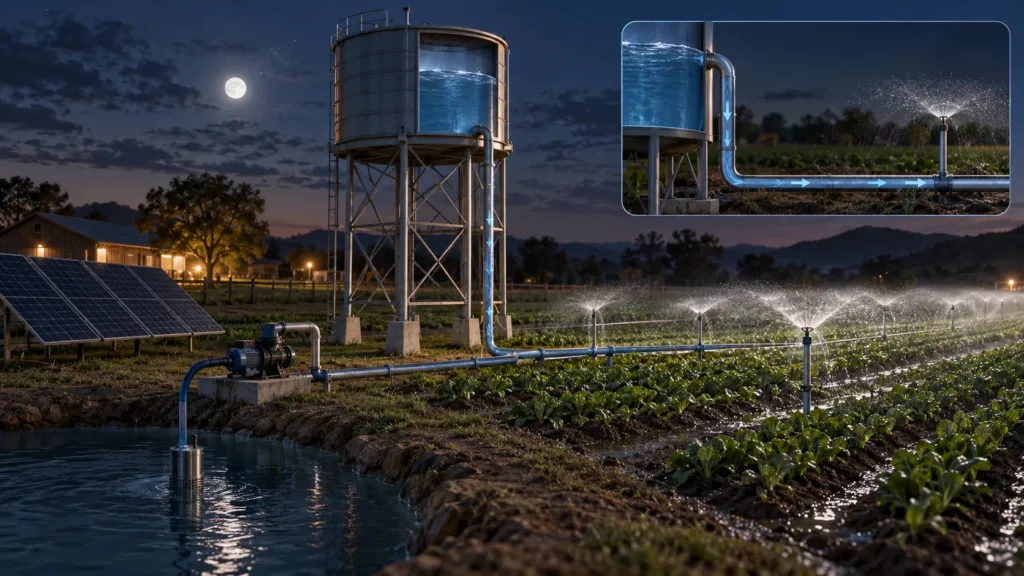
A water tank is often practical when the application is driven by daily volume and water can be pumped during available sunlight. Common examples include agricultural irrigation, livestock watering, remote borehole supply, and community water systems with adequate storage and suitable distribution pressure.
A correctly configured level sensor or float control can stop the pump when the tank is full, while dry-run or water-shortage protection can help protect the pump when the source cannot supply water. These functions depend on the actual controller and sensor configuration and must be confirmed from the product documentation.
Tank-based systems still require proper engineering. The design should address tank hygiene, screened vents, overflow, drainage, structural support, safe access, leakage, water quality, and local weather conditions. Tank elevation determines available static pressure: each metre of water head provides approximately 9.81 kPa, or 0.098 bar, before pipe, valve, filter, and fitting losses. If the required outlet pressure is higher, the system may need greater elevation or a separately designed booster arrangement.
When Does Battery Storage Make Sense?
Battery storage may be appropriate when the pump itself must operate during darkness or low-sun periods, when a pressure booster must be powered after sunset, when the site cannot accommodate adequate water storage, or when a controlled pumping schedule is essential. It should be selected because the service requirement justifies it, not because every solar installation is assumed to need a battery.
A battery-backed design must account for the actual pump or booster load, starting behaviour, controller or inverter compatibility, required operating time, usable battery capacity, charging conditions, allowed depth of discharge, ambient temperature, protection devices, and future replacement. These inputs vary by battery chemistry and system architecture, so a universal lifespan, efficiency, or payback figure should not be applied to every project.
A low-yield well also needs careful hydraulic planning. A battery cannot increase the sustainable yield of the water source. Depending on the site, a lower pumping rate, longer permitted pumping window, intermediate water storage, water-level control, or a different operating schedule may be more appropriate. For related low-light considerations, see whether solar water pumps work on cloudy days.
Solar Pump System Matching
Tank, Battery, or AC/DC Backup?
Send your daily water demand, required flow, total dynamic head, borehole diameter, pipe details, tank height, site location, and available backup source. Cloudsun Pump can match the pump, MPPT controller, and storage approach to the actual duty point.
Is AC/DC Backup an Alternative to Batteries?
Where the selected pump and controller support it, an AC/DC system may use solar as the preferred source and switch to an approved grid or generator supply when solar input is insufficient. This can provide operating flexibility without an electrical battery bank, especially where an existing backup source is reliable.
Automatic source switching is not the same as simultaneous AC/DC power blending. The actual switching logic, acceptable input ranges, protection functions, and source requirements must be verified from the exact controller documentation. Do not assume that every product marketed as hybrid combines both sources at the same time.
Backup power also does not correct an undersized pump, an unsuitable duty point, a weak water source, excessive pipe loss, or an incorrectly configured PV array. The pump, controller, panels, cables, protection, pipework, and storage strategy must still be selected as one system.
Cloudsun Pump Configurations for Direct Solar and AC/DC Systems
Cloudsun Pump offers 3-inch and 4-inch stainless-steel solar submersible pump configurations for boreholes, agricultural irrigation, livestock watering, and remote water supply. Depending on the selected series and duty point, a system may use direct DC operation or AC/DC automatic source switching with an MPPT solar pump controller.
Available model-specific protection functions can include dry-run or water-shortage protection, tank-full stop, over-voltage, under-voltage, over-current, and phase-loss protection where applicable. Pump construction, motor type, input range, and protection functions must be confirmed from the current datasheet for the exact model. Cloudsun can also provide OEM/ODM and project-specific configuration support.
A model should be selected from the required flow at total dynamic head, sustainable source yield, borehole diameter, water conditions, controller limits, and PV-array design—not from maximum head, maximum flow, or horsepower alone. The final configuration should be checked against the verified pump curve and controller documentation before quotation or installation.
How to Size a Water Tank for a Solar Pump
Tank sizing begins with water demand rather than pump horsepower. First determine the required daily water volume. Then define the reserve period, estimate dependable refill performance during the design season, and check how much tank volume is actually usable.
A preliminary planning formula is:
Preliminary usable storage = Daily water demand × Required reserve period
This formula is a starting point, not a final tank specification. Final capacity should consider refill timing, seasonal solar resource, source yield, pump performance at the required total dynamic head, unusable tank volume, operational reserve, leakage or evaporation where relevant, sanitation requirements, and local structural rules.
For example, if a livestock project requires 12 m³/day and the owner wants one full day of usable reserve, the preliminary usable storage target is 12 m³. The physical tank may need additional capacity, but the final selection should be checked against actual site conditions and the verified pump curve.
Tank elevation must also be checked against required outlet pressure and pipe friction. For the complete duty-point method, including dynamic water level, total dynamic head, well yield, and controller matching, see how to size a solar submersible pump for a deep well. For crop-water applications, use our guide to size a solar water pump system for irrigation.
What Information Is Needed Before Selecting the System?
A reliable recommendation requires the hydraulic, electrical, and application data for the real site. Prepare the following information before selecting the pump and storage method:
- Application and daily water demand: Irrigation, livestock, household, community, or another defined use.
- Required flow and delivery schedule: The necessary flow at the actual delivery point and when the water is needed.
- Water source and sustainable yield: Well, borehole, pond, river, or tank, including tested yield and recovery where applicable.
- Static and dynamic water levels: Required for vertical-lift and drawdown assessment.
- Delivery elevation and required outlet pressure: Includes tank inlet height or pressure-dependent irrigation equipment.
- Pipe data: Length, internal diameter, material, valves, filters, and fittings for friction-loss calculation.
- Borehole data: Internal diameter, total depth, planned pump installation depth, and cable or pipe clearance.
- Location and design-season solar conditions: Required for PV-array and daily-volume assessment.
- Storage or backup requirement: Tank size and elevation, battery-backed operating time, or available grid or generator supply.
- Water conditions: Temperature, sand or sediment, and water chemistry relevant to material selection.
These inputs allow the pump duty point, controller, PV array, pipework, protection, and storage method to be evaluated together. Selecting from maximum head, maximum flow, or horsepower alone can lead to poor delivery or unreliable operation.
Frequently Asked Questions
Can a solar water pump run directly from solar panels?
Yes, when the pump and controller are designed for direct PV operation and the array remains within the required voltage, current, and power limits. Do not connect an arbitrary pump directly to PV modules without a compatible controller and verified electrical design.
Can a solar water pump run at night without a battery?
The pump needs another suitable power source to operate at night. However, the water supply can continue from a storage tank if its usable volume, elevation, distribution losses, and required pressure have been correctly designed.
Is a water tank always cheaper than batteries?
No. Project cost depends on tank capacity, foundation, elevation structure, transport, battery chemistry, required autonomy, controls, installation, maintenance access, and local labour. Compare complete installed and lifecycle costs under the same service requirement.
Can an AC/DC solar pump work when sunlight is weak?
A compatible AC/DC system may switch to an approved grid or generator source when solar input is inadequate. The available function, switching logic, voltage range, and protection requirements must be verified from the exact pump and controller documentation.
How much tank capacity does a solar pump need?
Begin with daily demand and the required reserve period, then check reliable refilling, seasonal solar conditions, sustainable source yield, usable tank volume, water quality, pressure, and the required service level. There is no universal number of storage days that suits every project.
Maintenance and Reliability Checks
A battery-free system still needs inspection. Check PV-module cleanliness and mounting, cable and connector condition, controller ventilation and protection, pump current and flow, well drawdown, float or level controls, tank hygiene, overflow, valves, pipe leakage, and structural supports. Maintenance frequency should follow the actual environment and manufacturer documentation. Use our solar water pump maintenance checklist as a starting point.
For technical background on storing water instead of electricity in suitable solar pumping schemes, consult the Oxfam Solar Pumping for Water Supply guide and the Energypedia water-storage technical presentation.
Conclusion
Batteries are optional in many solar water-pumping systems, but they are not unnecessary in every case. For irrigation, livestock, and other volume-driven applications, direct solar pumping into a correctly sized tank can provide a practical way to make water available outside pumping hours. For applications requiring the pump or pressure booster to run independently of sunlight, battery storage or a compatible AC/DC backup source may be more appropriate.
The best decision comes from the service requirement and duty point: daily volume, required flow, total dynamic head, source yield, pressure, solar conditions, storage space, and available backup power. Match the pump, controller, PV array, pipework, protection, and storage strategy as one system rather than selecting from horsepower or a single maximum-performance number.
Project Selection Support
Send the Duty Point. Get the Right Configuration.
Share the application, daily water volume, required flow, total dynamic head, borehole diameter, pipe length, tank elevation, site location, available power, and water conditions. Cloudsun Pump will review the information and recommend a suitable pump and controller configuration.