
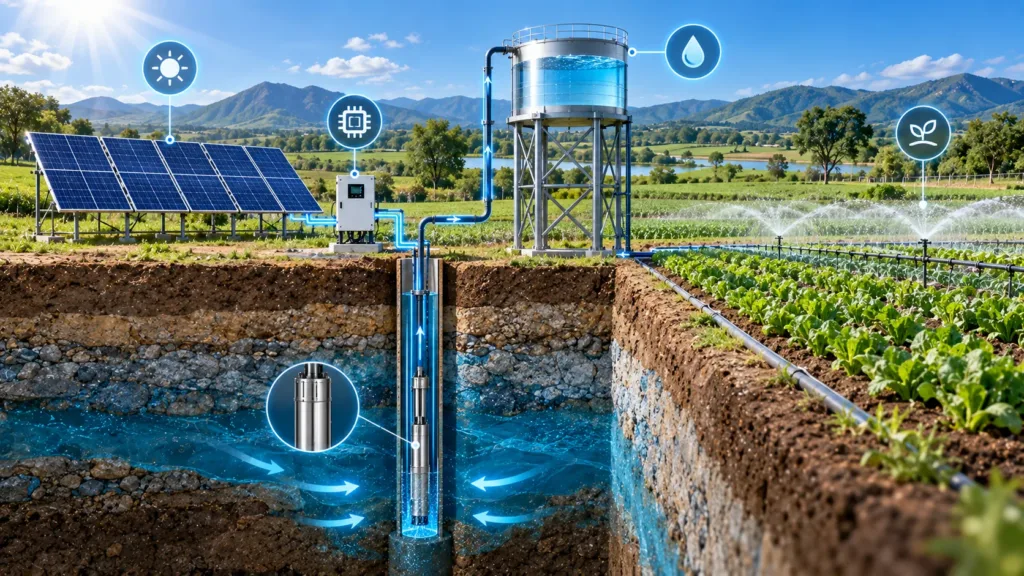
How do you size a solar submersible pump for a deep well? Start with the daily water requirement, convert it into the required pumping flow, determine the dynamic water level, calculate total dynamic head (TDH), and define the pump duty point. Then compare that duty point with a verified pump performance curve before sizing the controller and solar array.
Correct solar submersible pump sizing is not based on total well depth or motor horsepower alone. A 100 m deep borehole does not automatically require 100 m of pumping head, and a larger motor does not guarantee the correct flow at the actual operating head.
The most reliable sizing sequence is:
Daily Water Demand → Required Flow → Dynamic Water Level → Total Dynamic Head → Duty Point → Pump Curve → Well Yield → Borehole Size → Controller → Solar Array
Quick Answer: What Determines Deep Well Solar Pump Size?
| Design Value | Why It Matters |
|---|---|
| Daily water demand | Determines how much water must be pumped each day. |
| Required pumping flow | Defines how quickly the daily water volume must be delivered. |
| Dynamic water level | Determines the real lifting distance while the pump is operating. |
| Total dynamic head | Combines lift, elevation, pressure and friction losses. |
| Well yield | Limits how much water can be pumped sustainably. |
| Pump performance curve | Shows whether the pump can deliver the required flow at the required head. |
The key principle: select the pump from the required flow at the required head, not from maximum head, maximum flow or horsepower alone.
What Information Do You Need Before Selecting a Solar Well Pump?
Before choosing a pump, collect the following project information:
- Daily water requirement
- Total well or borehole depth
- Static water level
- Dynamic water level while pumping
- Well yield or recovery rate
- Borehole internal diameter
- Delivery elevation
- Pipe length and internal diameter
- Required outlet pressure, if applicable
- Required daily pumping hours
- Local solar conditions
- Water storage or backup requirements
Based on our experience manufacturing solar pumps for deep-well and off-grid water applications, these project values are far more useful for pump selection than simply asking for the well depth or motor horsepower.
For a broader overview of deep-well applications, see our solar submersible pump guide for remote wells and boreholes.
Step 1: Calculate the Daily Water Requirement
The first question is not how powerful the pump should be. It is:
How much water does the project need each day?
Daily water demand can depend on the application:
- Household water supply
- Livestock watering
- Agricultural irrigation
- Remote farm water supply
- Village or community water systems
- Water storage tanks
For example, suppose a project requires:
20,000 liters of water per day
This is equivalent to:
20 m³/day
For more help estimating farm and livestock water use, see our daily water requirements guide for livestock and irrigation.
Step 2: Convert Daily Water Demand Into Required Flow
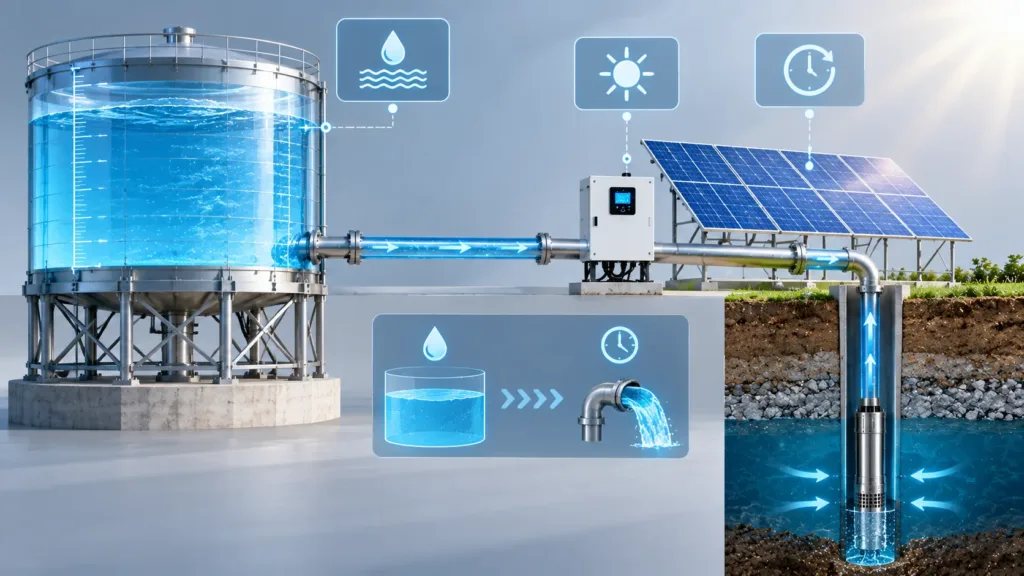
Once the daily water requirement is known, convert it into the required pumping flow.
A useful starting formula is:
Required Average Flow = Daily Water Demand ÷ Available Pumping Hours
Example
Daily water requirement:
20 m³/day
Example effective pumping period:
6 hours/day
Required average flow:
20 ÷ 6 ≈ 3.3 m³/h
That is approximately 14.5 GPM.
Important: six pumping hours is only an example. Solar pumping time depends on location, season, irradiance, PV-array configuration, pump characteristics, controller operation and whether water storage is used.
Step 3: Understand Static Water Level vs Dynamic Water Level
This is one of the most important parts of deep-well pump sizing.
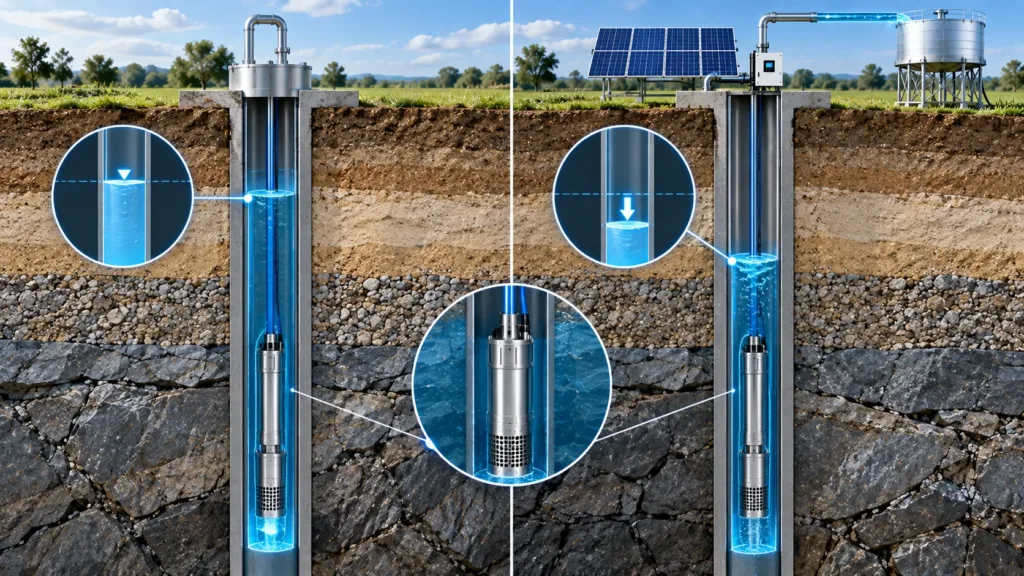
Static Water Level
The static water level is the water level in the well when the pump is not operating and the well has recovered.
Dynamic Water Level
The dynamic water level is the water level while the pump is operating.
When pumping begins, the water level usually drops below the static level. This difference is commonly called drawdown.
For pump sizing, dynamic water level is usually more important because it represents the actual lifting condition during operation.
Example
- Total well depth: 120 m
- Static water level: 50 m below ground
- Dynamic water level: 70 m below ground
The pump does not automatically need to lift water from the full 120 m well depth.
The actual vertical lifting calculation begins from the dynamic water level, plus any additional elevation, pressure and friction losses.
Step 4: Calculate Total Dynamic Head
Total Dynamic Head (TDH) is the total hydraulic head that the pump must overcome while delivering the required flow.
For a typical deep-well system that fills a storage tank:
TDH = Dynamic Water Level Lift + Delivery Elevation + Friction Losses
If the system also requires outlet pressure, include the required pressure head:
TDH = Dynamic Water Level Lift + Delivery Elevation + Pressure Head + Friction Losses
Example: Pumping to a Storage Tank
- Dynamic water level: 70 m
- Tank inlet: 10 m above ground
- Estimated friction loss: 8 m
The approximate TDH is:
70 + 10 + 8 = 88 m TDH
In feet, 88 m is approximately 289 ft.
If the system also needs pressurized irrigation, the required pressure head must be added separately.
Common mistake: well depth is not the same as total dynamic head.
Step 5: Define the Pump Duty Point
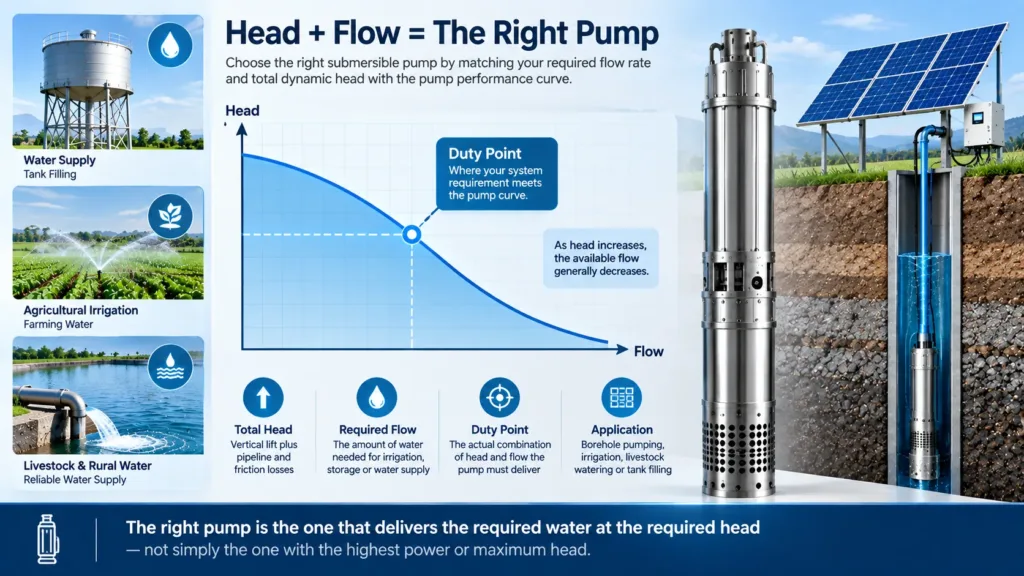
Once required flow and TDH are known, combine them into the required pump duty point.
Using the example above:
- Required flow: approximately 3.3 m³/h
- Required TDH: approximately 88 m
The design duty point is therefore approximately:
3.3 m³/h @ 88 m TDH (approximately 14.5 GPM @ 289 ft)
This duty point is the most important reference for selecting the pump model.
Step 6: Match the Duty Point to the Pump Curve
A pump performance curve shows how much flow a pump can deliver at different head levels.
Do not select a deep-well pump based only on:
- Maximum head
- Maximum flow
- Motor horsepower
Maximum head normally occurs near very low flow, while maximum flow occurs at much lower head. These values do not normally occur at the same operating point.
The correct question is:
Can this pump deliver approximately 3.3 m³/h at 88 m TDH?
The selected model should operate within an appropriate region of the manufacturer’s verified pump curve rather than at an extreme edge whenever practical.
Step 7: Check Well Yield and Recovery Rate
A correctly sized pump must also match the amount of water that the well can sustainably produce.
Important well parameters include:
- Tested well yield
- Drawdown
- Dynamic water level
- Recovery rate
For example, if the pump can deliver 5 m³/h but the well can sustainably provide only 3 m³/h, continuously operating the pump at 5 m³/h may cause excessive drawdown or dry-running risk.
A larger pump cannot create more groundwater.
Possible solutions can include:
- Lower pumping flow
- Longer pumping time
- Intermediate water storage
- Pump protection based on water level or dry-run detection, depending on the controller
Deep Well Pump Selection
Have Your Flow and TDH? Let Us Match the Pump.
Send us your daily water demand, required flow, dynamic water level, well yield, borehole diameter, delivery elevation, pipe length and required pressure. We can check the duty point and recommend a suitable solar submersible pump and controller configuration.
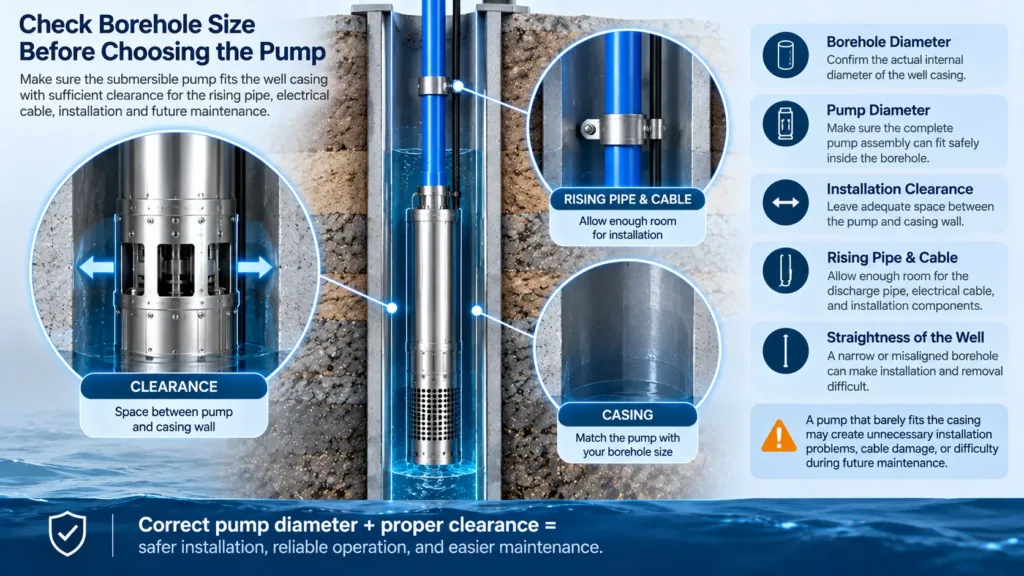
Step 8: Check Borehole Diameter and Pump Size
The pump must physically fit inside the borehole while allowing safe installation and adequate clearance.
Before choosing the pump diameter, confirm:
- Borehole internal diameter
- Casing diameter
- Pump outside diameter
- Power-cable clearance
- Rising-main pipe arrangement
- Centralizers or installation accessories where required
Common solar submersible pump sizes include 3-inch, 4-inch and larger configurations, but the correct size depends on the borehole and hydraulic requirement.
Typical Product Configuration for Deep-Well Solar Projects
For many agricultural, livestock and remote-water projects, 3-inch and 4-inch stainless-steel solar submersible pumps are practical starting options. Depending on the model and site requirements, the system may use DC or AC/DC operation with an MPPT solar pump controller.
The final model should still be selected from the required duty point, sustainable well yield, borehole clearance and controller compatibility rather than from pump diameter or horsepower alone.
Step 9: Check the Rising Main and Pipe Friction
Long or undersized pipes can create significant friction loss, especially in deep wells and long-distance water-delivery systems.
Friction loss depends on:
- Flow rate
- Pipe internal diameter
- Pipe length
- Pipe material
- Valves and fittings
If pipe friction is ignored, the selected pump may deliver less water than expected.
Increasing pipe diameter can reduce friction loss, although pipe cost and installation constraints must also be considered.
Step 10: Decide Whether to Pump Directly or Use Water Storage
For many off-grid deep-well systems, pumping water into a storage tank is easier to manage than trying to match water use directly to solar availability.
A common system configuration is:
Solar Panels → Controller → Submersible Pump → Storage Tank → Water Use
The pump can operate when sufficient solar power is available, while the stored water can be used later for:
- Livestock watering
- Household supply
- Irrigation
- Remote farm use
Water storage can therefore separate pumping time from water-use time.
Step 11: Match the Solar Pump Controller
After selecting the pump hydraulically, check the controller requirements.
Important parameters include:
- Pump rated voltage
- Pump rated power
- Motor type
- Controller input-voltage range
- Controller maximum input voltage
- Operating current
- PV-array voltage and power limits
Depending on the controller model, functions may include:
- MPPT
- Dry-run or water-shortage protection
- Tank-full stop or water-level control
- Over-current protection
- Over-voltage protection
- Under-voltage protection
For projects that require backup operation, an AC/DC hybrid configuration can be considered where supported by the pump and controller.
For a broader explanation of the electrical architecture, see our guide to the key components and working principles of solar water pumps.
Step 12: Size the Solar Array
The PV array should be designed only after the pump and controller have been selected.
Solar-array design should consider:
- Pump rated power
- Pump operating voltage
- Controller voltage range
- PV module Vmp
- PV module Voc
- Temperature effects on module voltage
- Local solar irradiance
- Seasonal solar variation
- Required daily water production
- Expected system losses
There is no universal number of solar panels for a deep-well pump.
The same pump may require a different number of modules when 450 W, 550 W or other PV modules are used, and the electrical configuration also depends on controller voltage limits and local conditions.
Design for the Critical Season
Do not evaluate the system only during the sunniest period of the year.
The better design question is:
Can the system deliver enough water during the period when water demand is high and solar conditions are less favorable?
For more background on reduced-sunlight operation, see our guide to solar water pump performance on cloudy days.
Complete Solar Submersible Pump Sizing Example
| Design Item | Example Value |
|---|---|
| Daily water demand | 20 m³/day |
| Example pumping time | 6 h/day |
| Required flow | 3.3 m³/h |
| Total well depth | 120 m |
| Static water level | 50 m |
| Dynamic water level | 70 m |
| Tank elevation | 10 m |
| Estimated friction loss | 8 m |
1. Calculate Required Flow
20 ÷ 6 ≈ 3.3 m³/h
2. Calculate TDH
70 + 10 + 8 = 88 m TDH
3. Define the Duty Point
3.3 m³/h @ 88 m TDH
4. Check the Pump Curve
Select a pump whose verified performance curve can deliver approximately 3.3 m³/h at 88 m of head.
5. Verify Well Yield
Confirm that the borehole can sustainably supply at least the required pumping rate under operating conditions.
6. Check Borehole Diameter
Confirm that the selected pump can be safely installed inside the casing with adequate cable and pipe clearance.
7. Match the Controller and PV Array
Use the selected pump’s electrical specifications, controller limits, PV-module data and local solar resource to complete the electrical design.
Important: this example demonstrates the sizing method only. Final pump selection must use actual project water demand, dynamic water level, well yield, pipe system and manufacturer pump curves.
Common Deep Well Solar Pump Sizing Mistakes
Using Total Well Depth as Pump Head
Total borehole depth and dynamic water level are different. Pump head should reflect actual operating conditions.
Selecting by Horsepower Alone
Horsepower does not show how much water a pump will deliver at the required head.
Using Maximum Flow and Maximum Head Together
Maximum flow and maximum head normally occur at different points on the pump curve.
Ignoring Dynamic Water Level
Static water level can underestimate the real lifting requirement while the well is being pumped.
Ignoring Well Yield
A pump cannot sustainably deliver more groundwater than the well can produce.
Ignoring Pipe Friction
Long or undersized rising mains can add substantial head loss.
Choosing Solar Panels Before Selecting the Pump
The hydraulic duty point should be determined before the PV array is finalized.
Using a Fixed Solar Panel Count
PV requirements depend on pump power, controller limits, module specifications, temperature and local solar conditions.
Deep Well Solar Pump Sizing Checklist
- Country and project location
- Application
- Daily water requirement
- Total well depth
- Static water level
- Dynamic water level
- Well yield or recovery rate
- Borehole internal diameter
- Required flow
- Delivery elevation
- Required outlet pressure
- Pipe length
- Pipe internal diameter
- Water storage requirement
- Required operating hours
- Available solar conditions
- Grid or generator backup availability
Frequently Asked Questions About Solar Submersible Pump Sizing
How do I size a solar submersible pump for a deep well?
Calculate daily water demand, determine the required pumping flow, identify the dynamic water level, calculate total dynamic head and define the required duty point. Then match that duty point to a verified pump performance curve before sizing the controller and PV array.
Is well depth the same as pump head?
No. Well depth is the total depth of the borehole. Pump head depends on dynamic water level, delivery elevation, required pressure and friction losses.
Should I use static or dynamic water level for pump sizing?
Dynamic water level is generally more useful for operating-head calculations because it represents the water level while the pump is running.
What is a pump duty point?
The duty point is the required flow at the required total dynamic head. It is the main reference used to compare the project requirement with a pump performance curve.
Can a larger horsepower pump solve low well yield?
No. Pump capacity cannot increase the natural recharge rate of the well. The selected flow should be compatible with sustainable well yield.
How many solar panels are needed for a deep-well pump?
There is no universal panel count. It depends on pump power and voltage, controller limits, PV-module Vmp and Voc, temperature, solar irradiance and required daily water production.
Can a solar submersible pump fill a storage tank?
Yes. Pumping into a storage tank is a common off-grid configuration because water can be pumped during available solar hours and used later.
Can a solar deep-well pump use grid or generator backup?
Where supported by the pump and controller, an AC/DC hybrid configuration can allow solar power to act as the primary source with grid or generator backup.
What information should I send a solar pump supplier?
Provide daily water demand, total well depth, static and dynamic water levels, well yield, borehole diameter, delivery elevation, pipe length and diameter, required pressure and project location.
Deep Well Solar Pump Sizing
Need Help Selecting a Pump for Your Deep Well?
Send us your well depth, static and dynamic water levels, daily water demand, well yield, borehole diameter, delivery elevation, pipe length, pipe diameter and required pressure. We can evaluate the required flow, TDH, pump size, controller and solar configuration for your project.