
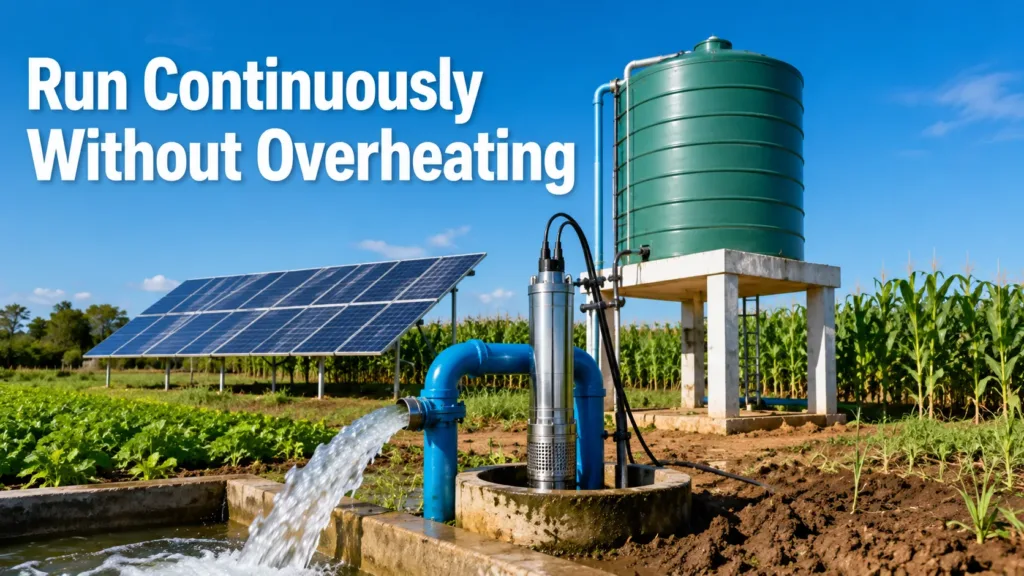
Farmers, borehole contractors, distributors, and well owners often ask the same question: how many hours can a submersible pump run continuously? This guide focuses on clean-water submersible well pumps and borehole pumps used for irrigation, livestock watering, tank filling, and rural water supply. It does not cover sewage, wastewater, sump, drainage, or construction dewatering pumps.
Short answer: A continuous-duty submersible well pump can run for many hours and, in a correctly designed system, may operate 24/7. However, there is no universal safe runtime. The actual limit depends on the model-specific pump and motor duty rating, cooling flow, dynamic water level, well recovery rate, operating point, power quality, and protection settings.
Being fully submerged is important, but submergence alone does not prove that a pump can run without limits. The installation must remain within the conditions stated on the nameplate, performance curve, datasheet, and manufacturer’s manual. A pump that is correctly selected may operate more safely in a long, stable cycle than an oversized pump that starts and stops too frequently.
What Does Continuous Duty Mean for a Submersible Pump?
Continuous duty means that a motor is designed to operate at its rated load for enough time to reach thermal equilibrium under specified conditions. It does not mean that every submersible pump can run indefinitely in every well. Water temperature, cooling flow, voltage, load, installation position, and the number of starts must remain within the limits for the exact model.
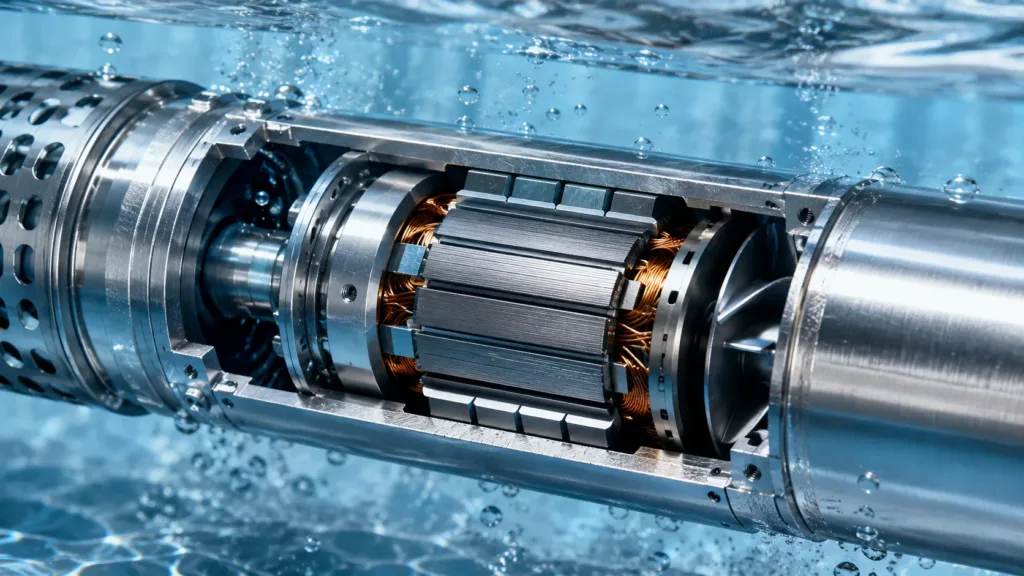
Do not judge duty capability from the words BLDC, DC, or AC alone. A brushless motor removes brush wear, but its safe runtime still depends on the complete motor design, controller settings, cooling conditions, and approved operating range. Before planning long operating hours, verify the duty rating on the pump and motor documentation.
Six Conditions That Determine Safe Continuous Runtime
1. Pump and Motor Duty Rating
The first check is whether both the pump and motor are rated for the intended duty. Some models are designed for continuous service, while others require a defined run-and-rest cycle. The manual may also specify maximum starts per hour or minimum time between starts. Exceeding these limits can increase thermal and mechanical stress.
2. Submergence and Cooling Flow Past the Motor
A submersible motor usually relies on water moving past its housing to remove heat. A pump can be underwater and still receive inadequate cooling flow. This may occur in an oversized well casing, an open tank, a top-feeding well, or an installation where water does not naturally move along the full motor body. In these cases, a correctly designed flow sleeve or cooling shroud may be required.
Minimum cooling-flow requirements vary by motor model, power, water temperature, and installation. Use the value in the applicable motor manual rather than applying one general number to every pump.

3. Well Yield, Drawdown and Dynamic Water Level
The borehole must recover water at a sustainable rate. If pump flow remains higher than well yield, the dynamic water level will continue to fall. The pump may then draw air, trigger dry-run protection, lose performance, or suffer damage.
Static water level is the level before pumping. Dynamic water level is the level while the pump is operating at a defined flow. A proper pump test should establish drawdown and sustainable well yield. Selecting a pump from total well depth alone is not enough.
4. Operating Point and Total Dynamic Head
The pump must work within the allowed range on its performance curve. Total dynamic head includes the vertical lift from the pumping water level, required outlet pressure, and friction losses through pipe, fittings, filters, and valves. A badly selected operating point can reduce efficiency, water output, and service life.
For a practical guide to deep-well system design, see our solar submersible pump guide for remote wells and boreholes.
5. Power Quality, Cable Sizing and Controller Settings
Long runtime requires stable electrical conditions. Check supply voltage, cable length and cross-section, voltage drop, operating current, controller limits, grounding, and generator capacity where applicable. A controller cannot correct every wiring or power-source problem.
Solar array sizing should be based on daily water demand, total dynamic head, local solar resource, seasonal conditions, pump performance, and system losses—not pump wattage alone. For variable-weather planning, review how solar water pumps perform on cloudy days.
6. Water Temperature, Sand and Water Chemistry
Water quality can limit runtime even when the motor remains cool. Check the selected model’s allowable water temperature, sand content, particle size, pH, chloride concentration, and material compatibility.
A screw or progressing-cavity pump is not automatically suitable for every sandy well; abrasive particles can also wear the rotor and elastomer stator. AISI 304 stainless steel provides useful corrosion resistance in many clean-water applications, but it is not immune to every groundwater chemistry. High-chloride or more aggressive conditions may require AISI 316 or another material after reviewing a water analysis.
Engineering Guidance
Can Your Well Support Long Pump Operation?
Share your dynamic water level, tested well yield, required flow, and total dynamic head. We’ll help you check the operating conditions and select a suitable pump.
How Many Hours Can a Submersible Pump Run in Different Systems?
| System | Practical Answer | Conditions to Check |
|---|---|---|
| Correctly installed continuous-duty well pump | May run for long periods, including 24/7 in some systems | Model rating, cooling flow, well yield, pump curve and protection |
| Solar-only submersible pump | Runs when adequate solar power is available; daily hours vary by location, season and weather | Daily water demand, solar resource and storage capacity |
| AC/DC hybrid system | May continue during weak sunlight or at night when suitable AC backup is available | Controller logic, power capacity and pump operating limits |
| Domestic pressure-tank system | Normally cycles according to demand; unusually long runtime may be normal or may indicate a fault | Leaks, pressure tank, pressure switch, well level and pump sizing |
| Intermittent-duty pump | Must follow the manufacturer’s run-and-rest cycle | Duty cycle and maximum starts per hour |
Solar-Only vs AC/DC Hybrid Water Supply
A solar-only pumping system normally operates when the array provides enough power. Pump speed and flow may change with irradiance, and the pump stops at night. Many off-grid projects pump water into a storage tank during daylight and distribute stored water when sunlight is unavailable. This approach can provide continuous water availability without forcing the pump to run continuously or adding an electrical battery bank.
An AC/DC hybrid system can use grid or generator power when solar energy is insufficient, if the controller and backup source are correctly sized. Some controllers automatically switch between power sources, while others may support a different operating logic. Only describe simultaneous AC/DC blending when the specific Cloudsun controller documentation confirms that function.
For livestock projects, calculate the required storage and daily pumping volume from realistic demand. Our livestock and irrigation water-demand guide provides a useful starting point.
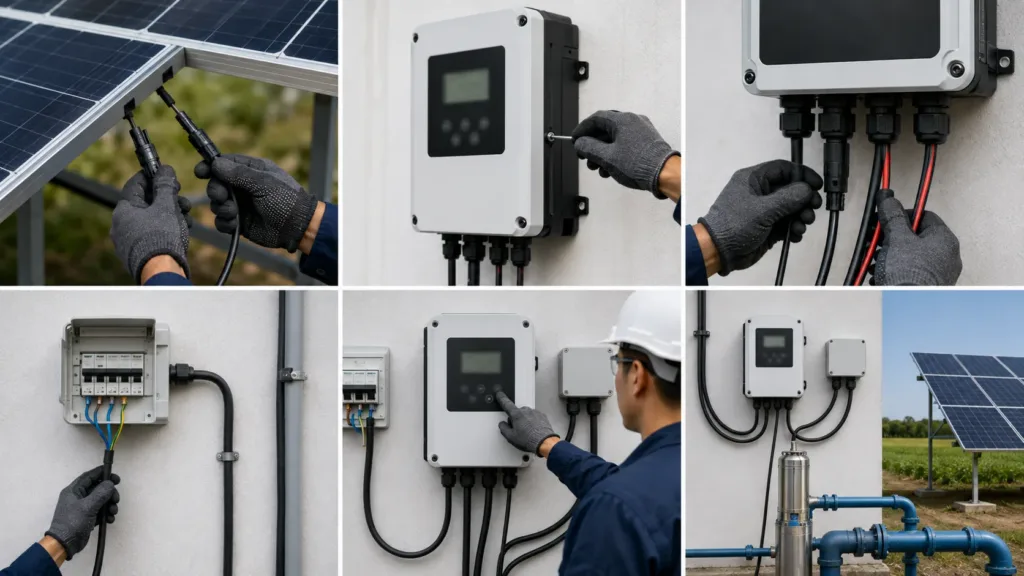
Warning Signs That the Pump Should Be Checked
- Flow or pressure falls noticeably.
- Water delivery contains air or becomes intermittent.
- Dry-run, overload, overcurrent, or overtemperature alarms occur repeatedly.
- Operating current moves outside the allowed range for the model.
- Sand or sediment suddenly increases.
- The pump runs but the storage-tank level does not rise.
- The pump starts and stops much more frequently than normal.
Stop the system and investigate repeated alarms instead of repeatedly resetting the controller. Check water level, intake condition, pipework, valves, electrical measurements, controller history, and pump performance against the approved data.
Information Needed Before Selecting a Pump for Long Operating Hours
- Borehole internal diameter.
- Total well depth.
- Static water level.
- Dynamic water level during a pump test.
- Tested well yield or recovery rate.
- Required daily water volume.
- Required flow rate.
- Vertical lift, pipe length, pipe diameter, fittings, and outlet pressure.
- Water temperature and available water-quality information.
- Available solar, grid, or generator power.
These details allow the pump, controller, solar array, cable, and storage tank to be selected as one system. You can also compare the main types of solar water pumps before requesting a model.
Frequently Asked Questions
Can a submersible well pump run 24/7?
It may run 24/7 if the exact pump and motor are rated for continuous duty and the installation meets all cooling, water-level, operating-point, power, and protection requirements. The model-specific manual takes priority over general online advice.
Does a submersible pump need rest time?
A continuous-duty pump does not require an arbitrary rest period simply because it has operated for several hours. An intermittent-duty pump must follow its specified run-and-rest cycle. Frequent starting can also be more stressful than a stable operating cycle, so observe the maximum starts stated by the manufacturer.
How many hours can a solar submersible pump run per day?
There is no fixed daily number. Runtime depends on location, season, weather, solar-array size, controller starting threshold, pump load, and system design. Solar projects should be sized around required daily water volume rather than promised operating hours.
Can a solar well pump run at night?
A solar-only pump normally stops when solar power is insufficient. Water stored during the day can remain available at night. A compatible AC/DC hybrid system may continue with grid or generator backup, subject to the controller and pump specifications.
What happens if pump flow exceeds the well recovery rate?
The dynamic water level may fall until the pump draws air or the dry-run sensor stops the system. Repeated drawdown can interrupt supply and may damage an unprotected pump. Reduce flow, select a different duty point, increase storage, or confirm a more sustainable operating schedule.
Does frequent starting damage a well pump?
Excessive starting can add electrical and mechanical stress. Check the model’s maximum starts per hour and inspect the pressure tank, pressure switch, leaks, controller settings, and pump sizing if short cycling occurs.
Is a flow sleeve always necessary?
No. It depends on the motor, well geometry, water-entry direction, installation position, and natural cooling flow. Use a flow sleeve when the motor manufacturer or installation design requires one.
Technical References
- Franklin Electric AIM: Application, Installation and Maintenance
- Grundfos: Submersible Pump Cooling Jacket
- LORENTZ: Dry-Run Protection Troubleshooting
Conclusion
A submersible well pump does not have one universal maximum runtime. Safe operation depends on the exact duty rating and on the complete system: cooling flow, well yield, dynamic water level, total dynamic head, electrical supply, water quality, and protection settings.
For reliable irrigation, livestock watering, tank filling, or remote water supply, select the pump from real site data rather than choosing from horsepower or well depth alone. Cloudsun Pump can review your borehole and water-demand information and recommend a suitable pump, controller, solar array, and storage approach.
Start Your Project
Need a Pump for Reliable Water Supply?
Send us your borehole depth, dynamic water level, required flow, pipe length, daily water demand, and available power for a model-specific recommendation.